Foundation Fieldbus is one of the most important digital communication technologies used in modern process industries. As industries continue moving from conventional analog systems toward intelligent automation networks, the demand for engineers with Foundation Fieldbus knowledge is increasing rapidly.
A professional Foundation Fieldbus Training Course helps engineers understand how smart field devices communicate digitally with Distributed Control Systems (DCS), how fieldbus segments are designed, how communication scheduling works, and how real industrial systems are integrated and maintained.
This technology is widely used in industries such as oil & gas, power generation, petrochemical plants, refineries, pharmaceuticals, LNG terminals, and chemical industries.
What is Foundation Fieldbus?
Foundation Fieldbus (FF) is an all-digital, bidirectional industrial communication system designed for process automation industries. It enables communication between intelligent field devices and host systems such as DCS, PLC, asset management systems, and operator workstations.
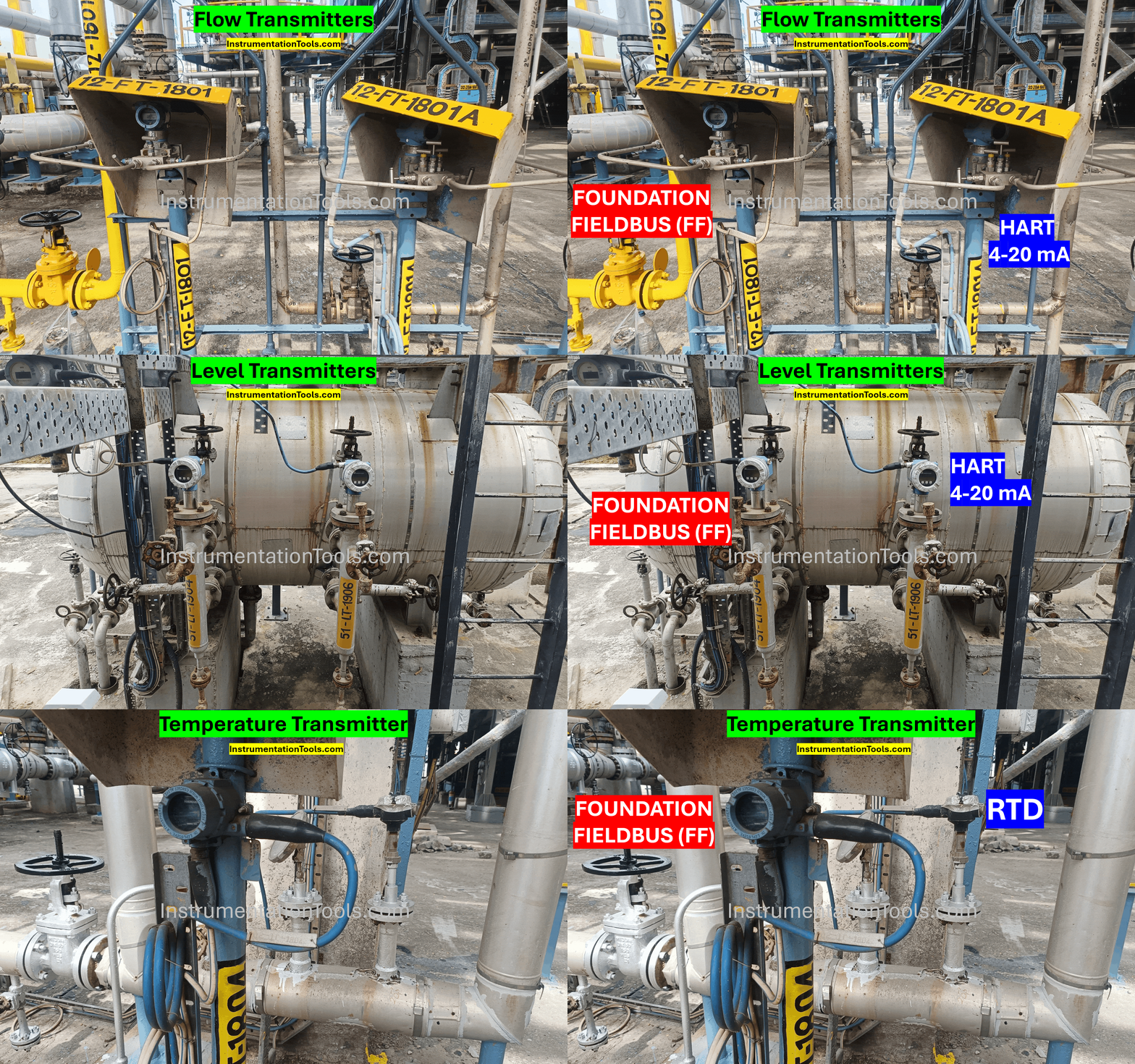
Unlike traditional 4 to 20 mA analog systems, Foundation Fieldbus allows multiple devices to communicate digitally over a single twisted-pair cable while also supporting power transmission through the same cable.
Foundation Fieldbus supports:
- Smart pressure transmitters
- Temperature transmitters
- Flow meters
- Level transmitters
- Valve positioners
- Process controllers
- Asset management systems
Why Learn Foundation Fieldbus?
Modern industries are adopting smart instrumentation and digital communication technologies to improve efficiency, diagnostics, maintenance, and process reliability.
Learning Foundation Fieldbus helps engineers understand:
- Digital industrial communication
- Smart instrumentation
- Field device integration
- DCS communication
- Distributed control
- Segment design
- Troubleshooting and diagnostics
- Communication scheduling
- Industrial networking concepts
Engineers with practical Foundation Fieldbus knowledge are highly valuable in commissioning, maintenance, operation, and automation projects.
Foundation Fieldbus Course
Learn FOUNDATION Fieldbus Communication from Basics to Advanced Industrial Applications.
| S.No. | Foundation Fieldbus Training | Videos |
|---|---|---|
| 1 | Introduction to 4-20 mA Signals | Fieldbus Course | Video |
| 2 | 4-20 mA Instruments in Industries | Fieldbus Training | Video |
| 3 | Field Instruments Junction Box & Cables Explained | Video |
| 4 | Inside 4–20 mA Junction Box | Practical Instrumentation Training | Video |
| 5 | 4–20 mA versus Foundation Fieldbus Instruments Explained | Video |
| 6 | Introduction to Foundation Fieldbus (FF) | Video |
| 7 | Why was Foundation Fieldbus Developed? – Industrial Communication Protocol | Video |
| 8 | Types of Foundation Fieldbus – Basics Training Course | Video |
| 9 | H1 and HSE Communication | Foundation Fieldbus Course | Video |
| 10 | Foundation Fieldbus Trunk and Spur Cables – Engineering Training | Video |
| 11 | Inside Foundation Fieldbus Junction Box | Technology Courses | Video |
| 12 | Fieldbus Tutorials: Field Barriers, Isolation Switch, Surge Protection | Video |
| 13 | Fieldbus Terminator – FOUNDATION Fieldbus Technology Training | Video |
| 14 | Fieldbus Loop Diagram – Wiring Explained | Video |
| 15 | Fieldbus Topology – FOUNDATION Fieldbus Engineering Training | Video |
| 16 | Foundation Fieldbus Tutorial: Device Address Explained | Video |
| 17 | Link Active Scheduler (LAS) – Training Course on Foundation Fieldbus | Video |
| 18 | Publisher Subscriber Model – Fieldbus Technology in Industrial Automation | Video |
| 19 | Cyclic Communication – Foundation Fieldbus Protocol Basics | Video |
| 20 | Client Server Model – Fundamentals of Fieldbus Technology | Video |
| 21 | Acyclic Communication – Industrial Fieldbus Protocol Training | Video |
| 22 | Foundation Fieldbus Training: Cyclic vs Acyclic Communication | Video |
| 23 | What is Macrocycle in Foundation Fieldbus? (Online Courses) | Video |
| 24 | Foundation Fieldbus Macrocycle Practical Example Explained | Video |
| 25 | Distributed Control in Foundation Fieldbus Explained for Beginners | Video |
| 26 | Foundation Fieldbus Basics: One-to-Many Communication Explained | Video |
| 27 | Foundation Fieldbus Tutorial: From Field to DCS System Explained | Video |
| 28 | DCS Marshalling Cabinet Explained – Foundation Fieldbus Tutorials | Video |
| 29 | DCS System Cabinet Explained – FOUNDATION Fieldbus Training | Video |
| 30 | Typical Foundation Fieldbus Wiring Diagram | Video |
| 31 | DCS Programming for Fieldbus Devices – Online Course | Video |
| 32 | DCS Programming – Fieldbus Device Panel Configuration | Video |
| 33 | DCS System Configuration – Fieldbus Builder Programming | Video |
| 34 | Distributed Control System (DCS) Tutorial: Fieldbus Control Drawing Builder | Video |
| 35 | DCS Engineering Training – Graphic Design for Control Systems | Video |
| 36 | Advantages of Foundation Fieldbus (FF) | Industrial Automation Course | Video |
| 37 | Disadvantages of Foundation Fieldbus | Instrumentation Course | Video |
| 38 | Practical Training for Instrumentation Engineers | Video |
| 39 | Control Valve Positioner Calibration | Instrumentation Tools | Video |
🔒 Note: YouTube Membership is required to access and watch these FOUNDATION Fieldbus training videos.
🎓 Exclusive training content for serious Instrumentation & Automation learners.
🎓 You can also join the Foundation Fieldbus Training Course on the Automation Community website and learn complete FF communication, H1 concepts, segment basics, diagnostics, LAS, function blocks, and DCS programming and integration.
👉 Check here: Foundation Fieldbus Course
📚 Practical industrial concepts
⚙️ Real automation applications
🏭 Process plant engineering knowledge
Importance of Foundation Fieldbus in Modern Industries
Traditional analog communication systems have several limitations.
Limitations of Conventional 4–20 mA Systems
- One variable per signal
- More field wiring
- Limited diagnostics
- Difficult maintenance
- Less intelligent communication
- Limited remote configuration capability
Foundation Fieldbus overcomes these limitations by introducing fully digital communication and intelligent field devices.
Major Advantages of Foundation Fieldbus
Reduced Wiring
Multiple devices can communicate on the same segment, significantly reducing cable installation costs.
Advanced Diagnostics
Smart devices can provide health status, calibration data, alarms, and predictive maintenance information.
Better Communication Reliability
Digital communication improves signal integrity and reduces noise-related issues.
Distributed Control Capability
Control functions can run directly inside field devices using function blocks instead of depending completely on the DCS controller.
Easier Troubleshooting
Maintenance engineers can diagnose device problems remotely without physically visiting the field.
Types of Foundation Fieldbus
Foundation Fieldbus mainly consists of two communication levels.
H1 Foundation Fieldbus
H1 is the field-level communication protocol used for smart instruments.
Key Features of H1
- Communication speed: 31.25 kbps
- Supports communication and power on the same cable
- Used for field instruments and control devices
- Suitable for hazardous area applications
H1 communication is widely used for:
- Pressure transmitters
- Flow meters
- Valve positioners
- Temperature transmitters
- Level instruments
Foundation Fieldbus H1 can operate up to approximately 1900 meters without repeaters under standard conditions.
HSE (High-Speed Ethernet)
HSE is the higher-level Ethernet communication network used for connecting multiple H1 segments and host systems.
Features of HSE
- Ethernet-based communication
- High communication speed
- Integration between controllers and networks
- Supports higher-level plant communication
What You Will Learn in a Foundation Fieldbus Training Course
A complete Foundation Fieldbus course generally includes both theoretical concepts and practical industrial applications.
Fundamentals of Industrial Communication
Students first understand the basics of industrial communication systems.
Topics include:
- Analog vs digital communication
- Industrial networking basics
- Smart instrumentation
- Automation hierarchy
- Communication protocols
Introduction to Foundation Fieldbus

Students learn the fundamentals of Foundation Fieldbus technology.
Topics include:
- What is Foundation Fieldbus?
- Why Foundation Fieldbus was developed
- FF architecture
- Communication principles
- Process automation applications
The course also explains why industries moved from traditional analog systems to digital field communication networks.
Foundation Fieldbus Hardware
Practical understanding of hardware is extremely important.
Students learn about:
- FF junction boxes
- Trunk and spur wiring
- Segment protectors
- Power conditioners
- Isolation switches
- Surge protection
- Terminators
Correct installation and segment design are critical for reliable communication.
Terminators in Foundation Fieldbus
One of the most important practical topics is terminator placement.
Each Foundation Fieldbus segment requires exactly two terminators for stable communication. Incorrect termination can cause severe communication issues.
Students learn:
- Why terminators are required
- Terminator locations
- Effects of improper termination
- Signal reflection problems
Foundation Fieldbus Topology
The course explains different segment structures used in industries.
Students learn:
- Trunk and spur architecture
- Segment topology
- Cable length limitations
- Device connections
- Spur calculations
Real industrial loop diagrams are commonly used for practical understanding.
Device Addressing and Network Communication
Every Foundation Fieldbus device requires a unique address for communication.
Topics include:
- Device addressing
- Tag assignment
- Communication scheduling
- Network identification
- Segment communication
Link Active Scheduler (LAS)
LAS is one of the most important concepts in Foundation Fieldbus communication.
The Link Active Scheduler controls communication timing between devices and manages scheduled data exchange inside the segment.
Students learn:
- LAS operation
- Scheduled communication
- Communication token management
- Segment timing concepts
Communication Models in Foundation Fieldbus
Foundation Fieldbus supports multiple communication methods.
Publisher/Subscriber Model
Used for cyclic process data communication between devices.
Client/Server Model
Used for diagnostics, configuration, and non-time-critical communication.
Cyclic Communication
Used for real-time control data exchange.
Acyclic Communication
Used for diagnostics and background communication.
These concepts are essential for understanding real industrial FF systems.
Macrocycle in Foundation Fieldbus
The macrocycle defines the repeating communication cycle of the FF segment.
Students learn:
- Macrocycle timing
- Scheduled communication
- Cyclic data transfer
- Acyclic communication integration
- Control loop timing
Understanding macrocycles is critical for advanced troubleshooting and system optimization.
Function Blocks in Foundation Fieldbus
Function blocks are one of the core concepts of Foundation Fieldbus.
Common function blocks include:
- AI (Analog Input)
- AO (Analog Output)
- PID
- DI
- DO
- Arithmetic blocks
These blocks allow distributed control directly inside field devices.
Distributed Control in Foundation Fieldbus
Unlike conventional systems where all control happens inside the DCS controller, Foundation Fieldbus supports distributed control.
This means:
- Control strategies can execute inside field devices
- Communication load is reduced
- System reliability improves
- Faster control response is possible
Distributed control is one of the major advantages of Foundation Fieldbus technology.
Distributed Control System (DCS) with Foundation Fieldbus Devices
A practical FF training course also explains integration with Distributed Control Systems.
Students learn:
- DCS system architecture
- Marshalling cabinet
- System cabinet
- FF modules
- Device mapping
- Live data integration
- Graphics programming
- Faceplate creation
Practical DCS programming is extremely important for real industrial projects.
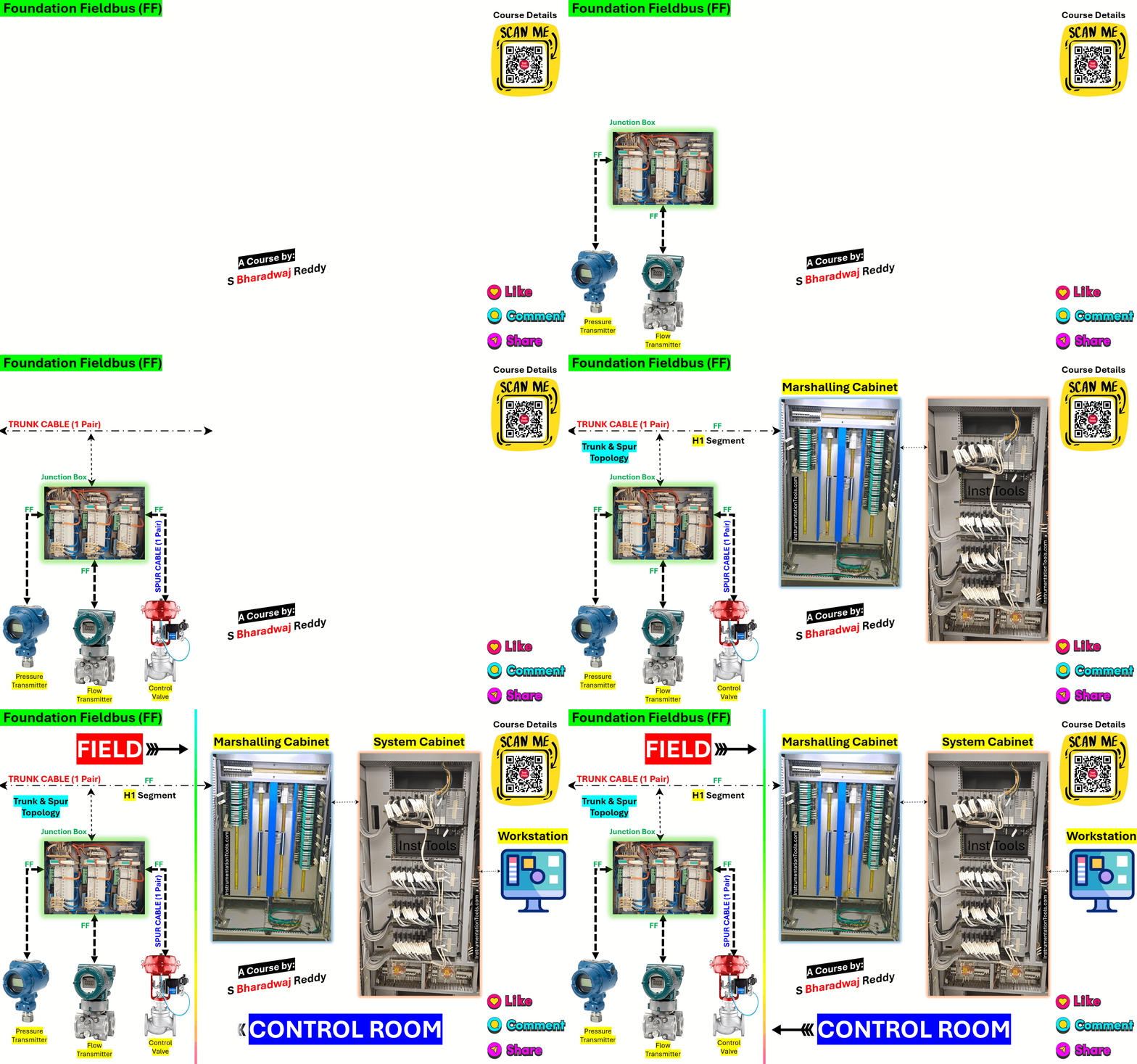
Foundation Fieldbus Segment
Segment is one of the most critical practical topics.
Topics include:
- Segment limitations
- Power requirements
- Cable limitations
- Intrinsic safety concepts
- Spur length specifications
- Grounding practices
Improper segment design can cause unstable communication and device failures.
Troubleshooting in Foundation Fieldbus
A good training course must include troubleshooting concepts.
Common problems include:
- Communication failure
- Noise issues
- Improper grounding
- Terminator issues
- Power supply problems
- Address conflicts
- Segment overload
- Device mismatch
Practical troubleshooting skills are highly valuable in industries.
Industries Using Foundation Fieldbus
Foundation Fieldbus is widely used in:
- Oil & Gas plants
- LNG terminals
- Refineries
- Power plants
- Petrochemical industries
- Chemical plants
- Pharmaceutical industries
- Water treatment plants
These industries depend heavily on reliable digital communication and smart instrumentation.
Who Should Join a Foundation Fieldbus Training Course?
This course is highly useful for:
- Instrumentation engineers
- Automation engineers
- DCS engineers
- PLC programmers
- Electrical engineers
- Maintenance technicians
- Commissioning engineers
- Engineering students
- Control system engineers
Benefits of a Foundation Fieldbus Training Course
After completing the course, students can:
- Understand FF communication architecture
- Configure Foundation Fieldbus devices
- Read FF loop diagrams
- Design fieldbus segments
- Troubleshoot communication issues
- Understand DCS integration
- Work with function blocks
- Understand distributed control systems
Foundation Fieldbus vs 4 to 20 mA
| Feature | 4–20 mA | Foundation Fieldbus |
|---|---|---|
| Communication Type | Analog | Digital |
| Diagnostics | Limited | Advanced |
| Wiring | More | Less |
| Multiple Variables | No | Yes |
| Remote Configuration | Limited | Yes |
| Device Intelligence | Low | High |
| Distributed Control | No | Yes |
Frequently Asked Questions (FAQ)
What is Foundation Fieldbus used for?
Foundation Fieldbus is used for digital communication between smart field instruments and control systems in process industries.
What is H1 in Foundation Fieldbus?
H1 is the field-level communication protocol operating at 31.25 kbps for field devices.
What is the role of LAS in Foundation Fieldbus?
The Link Active Scheduler (LAS) manages communication timing and scheduled data exchange between devices.
Why are terminators important in Foundation Fieldbus?
Terminators prevent signal reflections and ensure stable communication within the segment.
What industries use Foundation Fieldbus?
Industries such as oil & gas, chemical plants, power plants, refineries, pharmaceuticals, and petrochemical industries widely use Foundation Fieldbus.
Conclusion
Foundation Fieldbus is one of the most advanced and important communication technologies used in modern process automation industries. As industries continue adopting smart instrumentation and digital communication systems, engineers with Foundation Fieldbus expertise are becoming increasingly valuable.
A professional Foundation Fieldbus Training Course provides practical understanding of:
- Digital communication
- Smart instrumentation
- Segment specifications & wiring
- Communication scheduling
- Function blocks
- DCS Programming
- Distributed control
- Troubleshooting and diagnostics
For engineers working in industrial automation, instrumentation, DCS, PLC, or process control systems, learning Foundation Fieldbus can significantly improve technical skills and career opportunities.