In many plants, engineers face a strange problem where a machine or process suddenly stops due to an interlock, even though no PLC logic or settings were changed. When checked later, everything looks normal, and the fault is gone. These are often called “Ghost Interlocks.”
Ghost interlocks happen because the PLC reacts to very short or hidden disturbances that are not easy to see, such as brief signal fluctuations, loose wiring, momentary network delays, power dips, or timing issues inside the PLC scan. The PLC sees these events as real faults, even though they last only a fraction of a second.
Since they disappear quickly, operators and engineers feel the interlock triggered for no reason. Understanding ghost interlocks helps engineers stop blaming the logic and instead look at signals, communication, and timing issues that actually cause these false trips, and so, we will see this concept in this post.
What is Ghost Interlock?
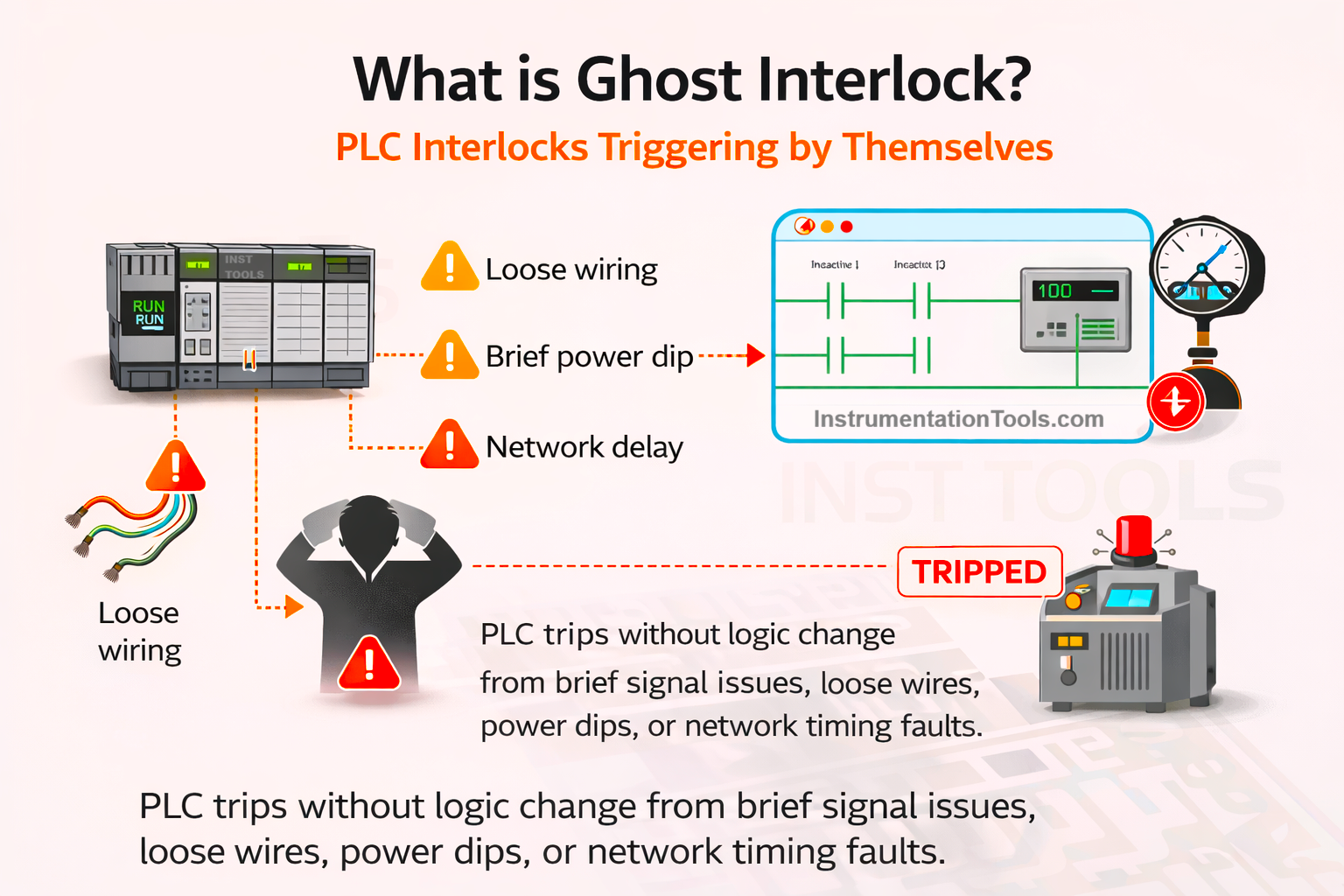
A ghost interlock is an interlock that trips or blocks a machine/process even though the PLC logic has not changed, and no real fault exists at that moment. In simple words, the PLC briefly “sees” a problem that humans never see. The signal may go bad for a very short time, sometimes only one PLC scan, and that is enough for the interlock to activate. By the time an engineer checks the system, the signal is already back to normal, so it feels like the interlock happened without any reason.
For example, pressure interlock trips, and when checked, the pressure is normal. No logic was modified, and no alarm is active now. That short, hidden disturbance caused a ghost interlock. A ghost interlock is not a logic bug. It is usually caused by momentary signal, communication, power, or timing issues that the PLC reacts to faster than humans can notice.
PLC Interlocks Triggering by Themselves
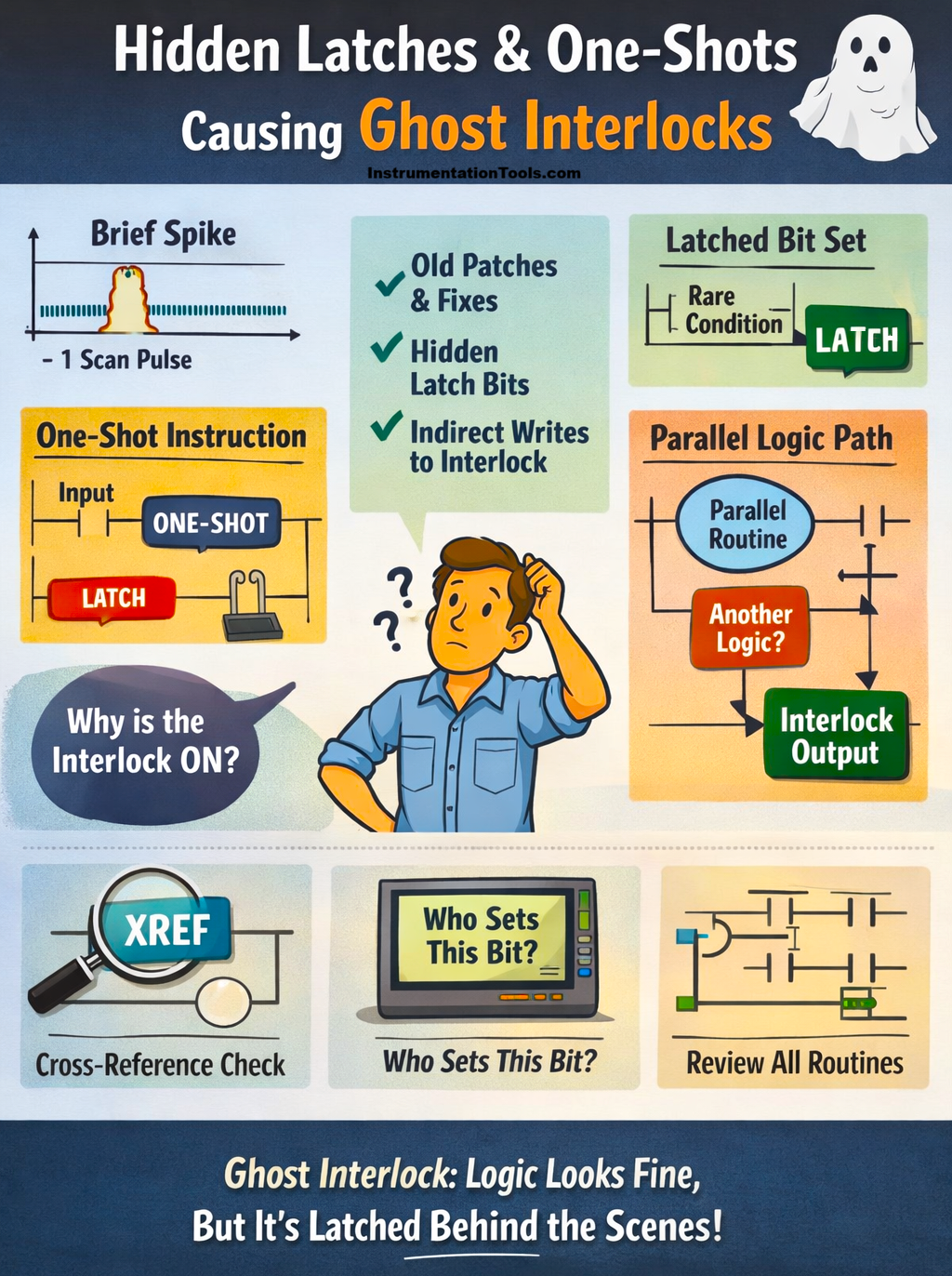
Let us now see some reasons below through which this can occur:
Input signal integrity issues
The most common cause of a ghost interlock is a momentary problem in the input signal coming to the PLC. Field signals (digital or analog) can briefly change due to loose terminals, cable vibration, electrical noise, poor grounding, or aging instruments.
These changes may last only a few milliseconds, but the PLC scans inputs very fast. If the signal crosses an interlock limit for even one scan, the PLC treats it as a real fault and triggers the interlock. By the time an engineer checks the value on the HMI, the signal is already back to normal, making the trip look mysterious.
Network communication glitches
In modern PLC systems, especially those using remote I/O over industrial Ethernet such as EtherNet/IP, PROFINET, or Modbus TCP, input data is not read directly from a hardwired module inside the PLC rack.
Instead, the PLC receives input data as cyclic packets over the network from remote I/O adapters or field devices. If there is packet loss, jitter, or increased latency, caused by overloaded switches, incorrect network topology, duplex mismatches, EMI, or poor cable quality, the PLC may miss one or more I/O update cycles. When this happens, the controller can temporarily:
- Mark the input data as invalid or bad quality
- Substitute the value with zero or the last-known state
- Momentarily drop the I/O connection and re-establish ownership
If the interlock logic does not explicitly evaluate connection status bits, module fault bits, or data quality flags, the PLC processes this invalid data as if it were a real process condition. Even a single missed update can be enough to satisfy an interlock condition and cause a trip. Since these communication disturbances often last only a few milliseconds, the network and I/O recover before alarms or diagnostics are logged, creating the illusion that the interlock occurred without any real cause, hence a ghost interlock.
IO module or firmware behaviour
I/O modules and communication adapters run their own internal firmware, independent of the PLC program. Over long operating periods, or under heavy network and temperature stress, these modules can experience brief internal resets, watchdog refresh delays, or self-diagnostic retries without declaring a hard fault.
During such events, the module may:
- Momentarily reset its output image
- Reinitialize analog input scaling
- Toggle status bits such as Module OK, Data Valid, or Connection Active
From the PLC’s point of view, this looks like a real change in the input state, even though the field device never changed. If firmware revisions between the PLC, I/O adapter, and modules are not fully compatible, these micro-resets become more frequent and harder to diagnose.
Because the module recovers within a few scans, no permanent fault is logged. However, the PLC logic has already reacted, and the interlock is latched or tripped. This makes the issue appear random and logic-related, while the true cause is firmware-level behavior inside the I/O hardware. This is why vendors often recommend firmware alignment and scheduled I/O module power cycling during major shutdowns.
PLC scan order and execution timing effects
A PLC does not execute all logic at the same time. It follows a fixed scan sequence: read inputs, execute logic, and update outputs. Within the logic phase, routines and tasks are also executed in a defined order. Ghost interlocks occur when interlock logic is evaluated before signal conditioning logic, such as filtering, scaling, or validation.
For example, an analog input may briefly spike due to noise. If the interlock compares the raw value in an early routine, but filtering or limit-check logic runs later in the scan, the interlock sees an unsafe condition for one scan only and trips.
This problem becomes more common when:
- Logic is expanded over time without reorganizing task order
- High-speed tasks read inputs faster than conditioning routines
- Event or periodic tasks interrupt normal execution
Even though the filtered value shown on the HMI looks stable, the interlock already acted on a temporary, unfiltered value. This is not a logic error, but a timing and structure issue.
Power quality events and retentive memory
Not all power problems completely shutdown a PLC. In many plants, very short power dips, brownouts, or UPS transfer events occur that are long enough to affect field devices and I/O modules but too short to stop the PLC CPU.
During such events:
- Sensors, transmitters, or remote I/O may reset or reboot
- The PLC continues running and retains latched or retentive bits
- Inputs may briefly drop to zero or false while devices restart
From the PLC’s perspective, this looks like a real process fault, so the interlock logic trips and latches the condition. When power stabilizes, the field devices return to normal, but the PLC remembers the interlock and stays in a tripped state.
Since no PLC fault or power-down is recorded, engineers often assume the logic is wrong when the real cause is power coordination between the PLC, I/O, and field instruments. This is why critical interlocks often need power-fail detection and revalidation logic.
Unhandled signal quality or status bits
Many PLC platforms attach status or quality information to analog and network-based signals. This includes states like GOOD, BAD, UNCERTAIN, NOT CONNECTED, or TIMEOUT.
However, in many programs, interlock logic checks only the signal value and completely ignores its quality. When communication is briefly disturbed, an instrument resets, or an analog module reinitializes, the signal quality may change to BAD or UNCERTAIN for a few scans.
During this time, the PLC may:
- Force the value to zero
- Hold the last value
- Output a default fallback value
If the interlock logic does not explicitly verify that the signal quality is GOOD, it evaluates this invalid value as real process data and trips the interlock. Once quality returns to GOOD, the value looks normal again, but the interlock has already fired. This creates a classic ghost interlock: the value looks fine, but it was never valid when the decision was made.
In this way, we saw the concept of ghost interlocks and how they can trigger an error condition without any logic change.