In every industrial automation project, temporary bypasses are sometimes unavoidable. During commissioning, breakdowns, or urgent production demands, engineers modify PLC logic to keep the plant running. At that moment, the intention is practical and short-term.
Temporary Bypasses in PLC Logic
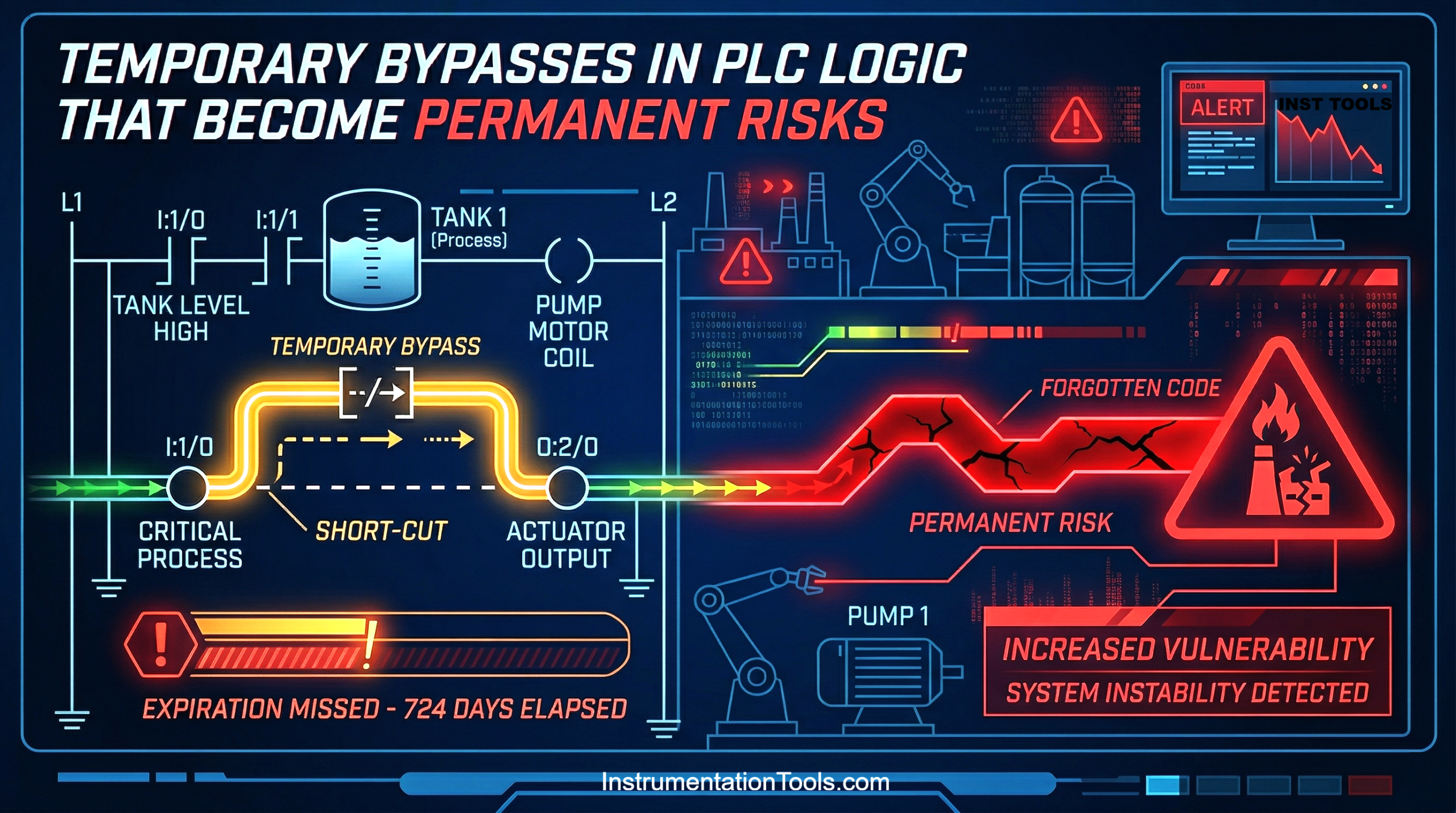
However, when these temporary changes are not tracked, reviewed, and removed, they quietly become part of the permanent control philosophy. Months or years later, no one remembers why the bypass exists, but it continues influencing the process. This is where risk begins.
A small shortcut taken under pressure can slowly weaken interlocks, reduce safety integrity, hide alarms, or distort control logic. The plant may run smoothly for years, creating a false sense of reliability. But when an abnormal condition occurs, these forgotten bypasses often turn minor disturbances into major incidents.
Forcing inputs and never removing them
During commissioning or troubleshooting, engineers often use the PLC’s force function to simulate field signals. For example, if a level switch is not yet installed or a proximity sensor is faulty, the input may be forced to ON so that downstream logic can be tested and production can continue. This is a normal and useful diagnostic practice when controlled properly.
The danger arises when the force is not removed after the work is completed. The PLC will continue to read the input as healthy, regardless of the actual field condition. If the real sensor later detects a fault, such as low level, high pressure, or equipment overload, the controller will ignore it because the forced value overrides the physical signal.
In effect, the interlock is silently disabled. The system appears stable, but one layer of protection has already been removed without anyone realizing it.
Hard-coding a healthy status
When an instrument starts giving unstable or faulty signals, instead of fixing the root cause immediately, someone may modify the logic to permanently assume the signal is healthy. For example, a condition like Motor_Run_Permissive = Pressure_OK may be altered to Motor_Run_Permissive = TRUE or combined with a maintenance bit that is never reset.
This allows the equipment to continue operating without resolving the actual field issue. Initially, this seems like a practical solution to avoid downtime. However, the process is now running without real validation from the field device. If the pressure actually drops below a safe limit or a protection condition occurs, the PLC will not respond as designed. The interlock still exists in the program, but it has effectively lost its function.
Over time, such hard-coded temporary fixes weaken the integrity of the control system and can lead to serious operational or safety incidents.
Safety interlock masked in logic
When a safety-related input, such as a limit switch, guard switch, or emergency feedback, starts causing nuisance trips, the quickest solution under production pressure is sometimes to mask or bypass that interlock in the PLC logic.
Instead of correcting alignment, wiring, or device health, the condition is temporarily ignored so the machine can continue running. This creates a dangerous illusion: the safety logic still appears present in drawings and documentation, but in reality, it no longer protects the process.
If a genuine hazardous situation occurs, the controller will not act because the trip condition has been intentionally suppressed. Over time, people forget that the interlock was ever bypassed. What began as a short-term workaround quietly reduces the system’s protection layers, increasing the severity of any future accident.
Alarm suppression left active
During unstable plant conditions or repeated nuisance alarms, operators may temporarily suppress certain alarms to reduce distraction and regain control of the process. In many systems, alarm masking or shelving features are provided specifically for this purpose.
When used correctly, this is a helpful operational tool. The risk begins when the suppression remains active longer than intended. If the alarm is not automatically restored or formally reviewed, critical warnings may stay hidden from operators. Slow equipment degradation, abnormal trends, or early fault indicators can go unnoticed because the system is no longer alerting anyone.
Over time, this removes an important layer of early detection. The plant may appear calm and quiet, but in reality, important signals are being ignored until a major failure forces attention.
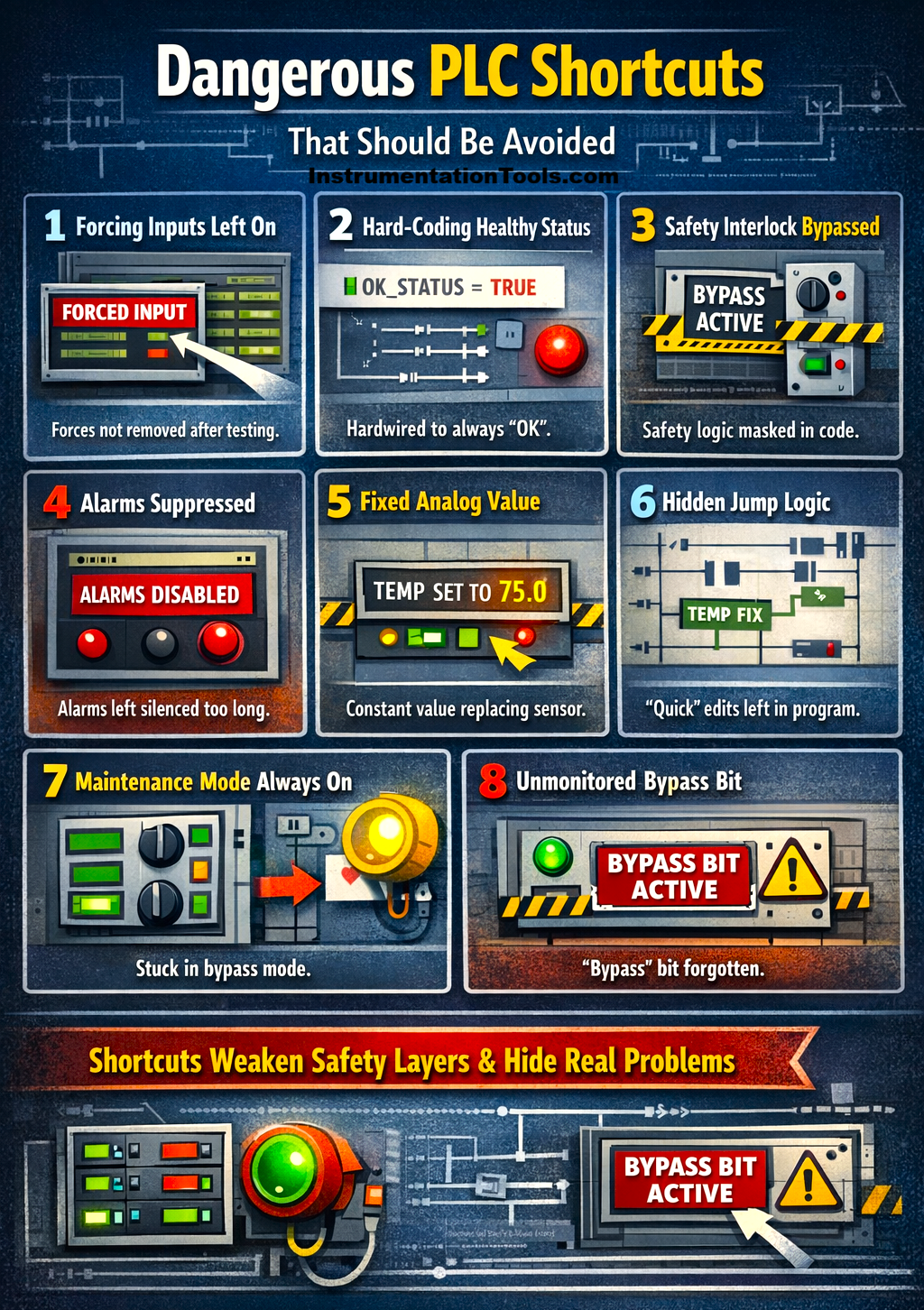
Temporary jump logic added during online edits
During breakdown situations, engineers sometimes add quick jump conditions or parallel permissives while performing online edits. For example, a new rung may be inserted to bypass a sequence step, skip a timer, or allow a motor to start without completing the full pre-start checks.
The intention is to restore operation quickly and then clean up the logic later. The problem is that these edits often remain undocumented. Because they are added under pressure, they may not follow the original control philosophy or sequencing structure. Months later, when someone else troubleshoots the system, the logic behaves differently than expected.
Sequence steps may be skipped under certain conditions, protections may not execute in the right order, and fault recovery may become inconsistent. These hidden branches increase complexity and reduce predictability, turning a quick fix into a long-term reliability risk.
Maintenance mode is left permanently enabled
Many PLC programs include a maintenance mode designed to temporarily relax interlocks, disable certain trips, or allow manual control for testing. When used correctly, this mode is controlled, time-bound, and supervised. It allows technicians to safely perform calibration, alignment, or equipment checks without triggering unnecessary shutdowns.
The risk appears when maintenance mode is enabled and never properly disabled, or when it becomes the default operating condition. In such cases, critical permissives and safety checks remain bypassed during normal production. Operators may not even realize that the system is running in a reduced-protection state.
Over time, this erodes the layered defense built into the control philosophy. The plant continues operating, but with safeguards quietly weakened, increasing vulnerability during abnormal events.