Duplicate alarms generated from a single field event are a frequent challenge in industrial automation systems, especially in complex PLC–SCADA architectures. In such cases, one real-world condition, like a sensor trigger, equipment fault, or process deviation, results in multiple alarm entries appearing in the system. This not only clutters the alarm interface but also confuses operators and can delay response to critical situations.
Duplicate Alarms
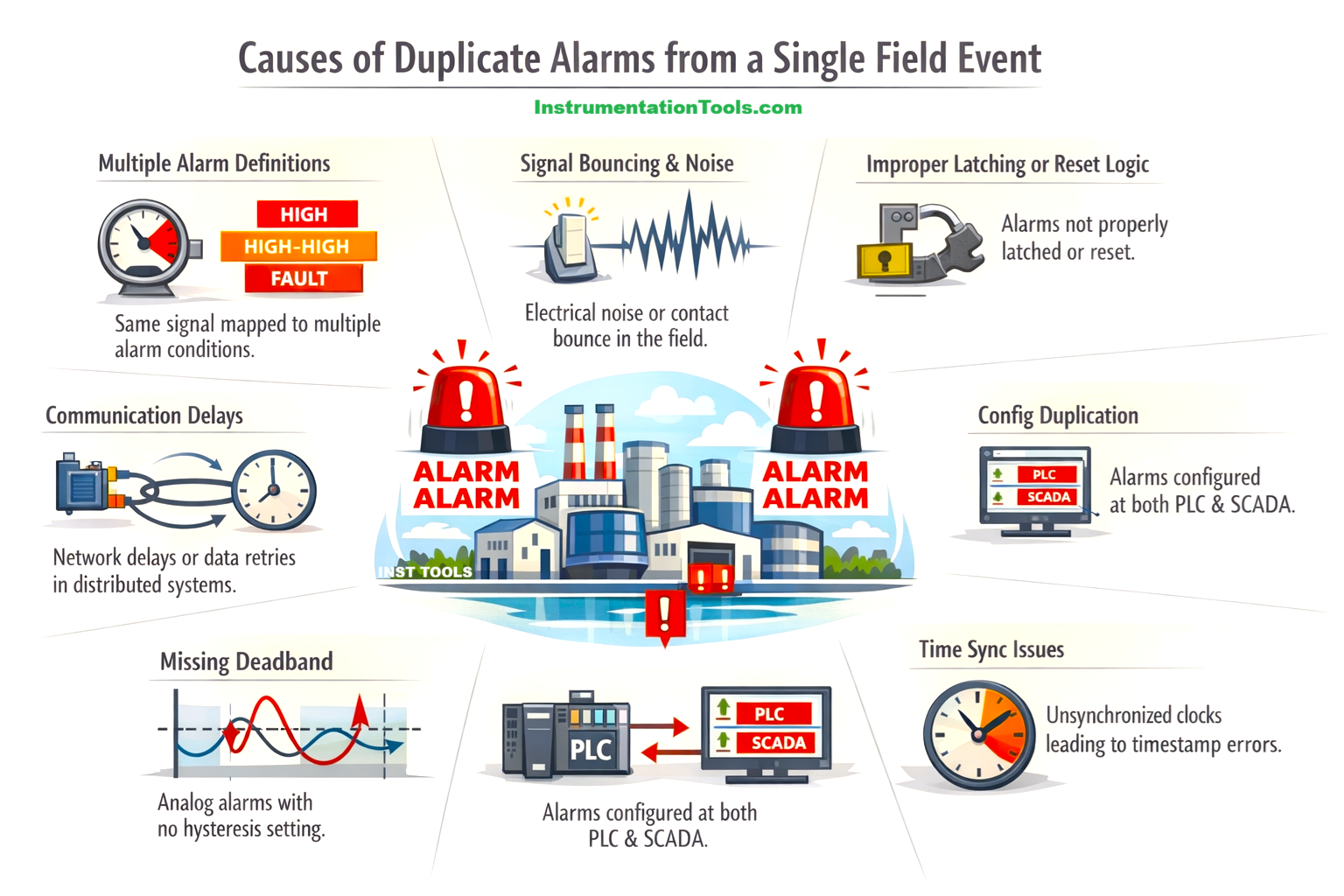
Understanding why a single event leads to multiple alarms is essential for maintaining alarm integrity, improving system reliability, and ensuring effective operator decision-making.
Multiple alarm definitions mapped to the same signal
The first major reason for duplicate alarms is multiple alarm definitions mapped to the same signal. In many automation systems, a single field tag, such as a pressure, temperature, or status signal, is reused across different alarm conditions. For example, one analog value might be configured to generate a High alarm, a High-High alarm, and sometimes even a fault or deviation alarm. If these alarm conditions are not clearly separated with proper limits, hysteresis (deadband), or priority handling, a single change in the signal can satisfy more than one condition at the same time.
In practice, this means that when the process variable crosses a threshold, the system may trigger multiple alarms simultaneously because it interprets the same event under different alarm rules. This becomes more problematic when alarm configurations are done at multiple levels, like both in the PLC and SCADA, without coordination. As a result, one field event ends up generating multiple alarm instances, even though the root cause is only one.
Signal bouncing or noise at the signal level
The next major cause is signal bouncing or noise at the field level. In real industrial environments, field signals are not always clean and stable. Mechanical devices like limit switches, push buttons, or relay contacts can physically vibrate or bounce when they change state. Similarly, electrical noise from nearby equipment, improper grounding, or long cable runs can introduce fluctuations in the signal.
Because PLCs scan inputs very quickly, even a brief fluctuation can be detected as multiple ON/OFF transitions within milliseconds. Each of these transitions may be interpreted as a separate event by the alarm logic, leading to multiple alarms being generated for what is actually a single physical occurrence. This is especially noticeable in systems where no input filtering or debounce logic is applied.
Improper alarm latching or reset logic
Another important cause is improper alarm latching or reset logic. In a well-designed system, once an alarm condition is detected, it is typically latched, meaning it stays active until it is acknowledged or the condition is fully cleared. However, if this latching mechanism is missing or incorrectly implemented, the alarm may not hold its state consistently.
In such cases, every time the PLC scan detects the alarm condition as true, it may treat it as a new occurrence instead of a continuation of the same event. Similarly, if the reset logic clears the alarm too quickly while the field condition is still unstable, the alarm can retrigger repeatedly. This results in multiple alarm entries being generated for a single continuous issue, making it appear as though multiple independent events have occurred.
Communication delays or retries in the distributed systems
Another contributing factor is communication delays or retries in distributed systems. In setups where PLCs, remote I/O, and SCADA are connected over networks, data is continuously exchanged in cycles. If there are network delays, packet losses, or retries, the same field event can be transmitted more than once.
From the SCADA or alarm server’s perspective, each received update may be treated as a fresh event, especially if there is no proper event tracking or handshake mechanism in place. This can result in multiple alarm entries being logged for a single actual occurrence in the field. The problem becomes more noticeable in systems with unstable networks or where communication buffering and retry logic are not properly tuned.
Alarm duplication due to configuration at multiple systems
Another subtle but common cause is alarm duplication due to configuration at multiple system levels. In many projects, alarms are configured both in the PLC (controller level) and again in the SCADA or HMI layer using the same field signal. While this is sometimes done for flexibility or visualization, it can lead to the same event being treated as two independent alarms.
In practice, when a field condition occurs, the PLC may generate an alarm internally, and at the same time, the SCADA system, which is monitoring the same tag, also generates its own alarm based on its configuration. Since both alarms originate from the same signal but are handled by different layers, they appear as duplicate alarms to the operator. This lack of coordination between control and supervisory levels often results in redundant alarm generation, even though the root cause is a single event.
In this way, we saw how duplicate alarms are generated from a single field event.