Substation automation is a very critical engineering portfolio. Due to the nature of critical electrical components, it is necessary to design the automation of these projects very carefully and efficiently.
SCADA Design for Electrical Substation
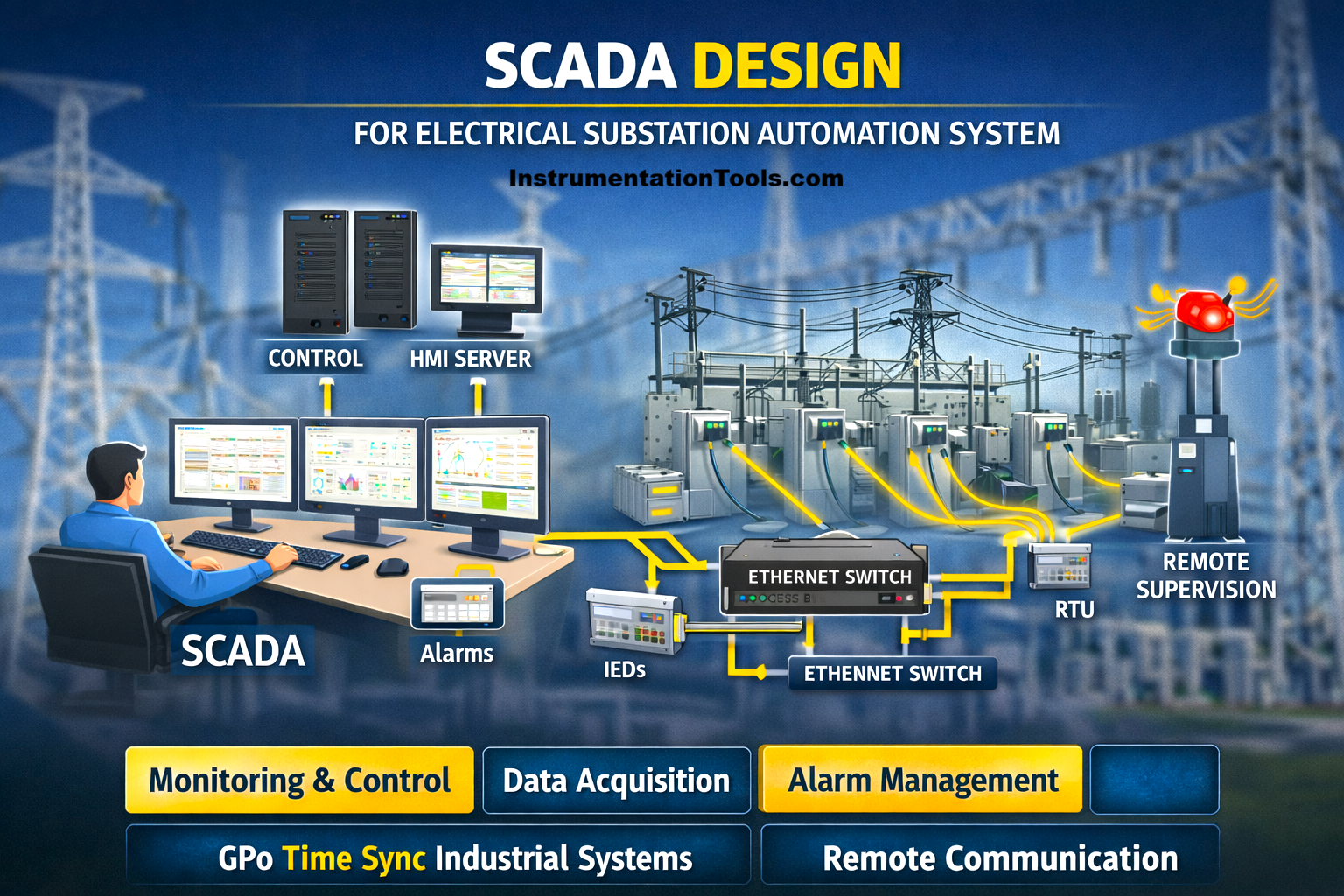
Particularly when you’re designing SCADA, utmost care must be taken by the programmers to ensure that it is compliant with international standards and also understood by the local operators very easily. In this post, we will see the points to consider when designing SCADA for substation automation.
Requirements and high-level scope
Be it any automation, it is first of all required to understand the needs of the project properly. Some sectors of automation are less critical, and some are very critical. Substation automation is a very critical sector, due to the requirement for electricity 24 hours a day. For that purpose, it is required to understand that they require SCADA 24 hours to operate without any failure, which in case will require a redundancy.
Also required is an understanding of which communication protocol will be used in the overall design. This is because some are slow, which will give alarms, timestamped events, or other critical data a little few seconds late. Accordingly, that protocol needs to be supported by the SCADA software. And as the operation of this plant is very critical, the programmer must know how many users and groups they can assign in the program with their respective privileges.
When we consider a typical scope of programming for a substation automation project, the general points covered are – inter communication of all the devices on various protocols, proper time-stamped events and alarms recording, continuous monitoring of energy consumption, feeder loads and health of devices, viewing each status of all the devices, and monitoring critical interlocks between breakers or other electrical devices (control is optional depending on the speed of communication). So, it is necessary to understand the scopes and requirements before proceeding further.
Architecture and redundancy
As discussed, redundancy is a very important part to understand, considering the criticality of the system. Apart from 2 servers, some may also require a control client or a view-only client at remote locations, where they can view the system efficiently from their offices.
Also, database integration is an important part to consider along with the historian server, for bulk data logging and management. The programmer must know how the two servers will perform for redundancy with the viewpoint of data sharing, and how quickly the secondary server becomes a primary server. And, it is also necessary to consider how many total engineering workstations will be required.
If there are local HMI’s in the plant, it should be asked whether redundancy is required at that level also or not. Redundancy not only works for SCADA stations, but also for networks and topologies. So care must be taken to consider them too whenever required. And the last step is to check whether firewalls or VLAN’s will be required in the system or not, so that the network will be configured accordingly.
Communication and protocols
Any major automation application cannot be complete without intercommunication between devices. The same goes for a substation. One thing to note is that apart from the major industrial communication protocols used, substation automation has a special protocol developed for itself called GOOSE (IEC 61850). This Ethernet-based protocol allows for the fastest communication between two IEDs (intelligent electronic devices), like meters, breakers, transformer relays embedded with them, in which one will be a server, and the other will be a client. Interlocking will be done through this protocol, thus ensuring protection of the whole circuit.
Apart from that, you also need to consider which communication protocols are used in your system, for which the corresponding drivers will be required in your software. For this, you need to properly go through the system and network architecture.
Tag Naming and Database Design
Electrical devices can have large names as per their location, type, position, and the voltage it carries. You need to properly go through the names of all the devices that will be communicated by your system, so that the corresponding tag list will be prepared by you before commissioning. Nowadays, modern programmers not only define tags, but also assign a structure with them.
For example, a meter can have its description, address, units of various parameters which you will read from it, scaling, alarm limits, digital or analog status to show, commands, and alarms associated. So, instead of creating individual tags, you can create a structure of these elements for a single tag, which can then be reused for other tags as well. This will make your program look more aligned and easier to understand.
Getting all the bulk information is necessary prior to selling the final quotation to the customer, because you need to know how many tags your SCADA program will consume tentatively. Accordingly, you can decide the licence model to be sold to the customer based on the final tag count. Always keep 30-40% spare before sending the final offer.
Alarms and events
As the devices will have a lot of electrical data and their alarms associated, it is necessary to document the alarms properly for engineering. It is then important to prioritise these alarms according to groups. Different alarms have their corresponding behaviors in the program, like latch until acknowledged, having deadbands for acknowledgement, etc. This also affects the PLC programming. So, as per the alarm nature and its effect on the system performance, a document must be made containing all the alarms and their nature of behaviour that needs to be programmed for the system.
Regarding events, like when a load device started or stopped, when the breaker was closed or opened, etc., all such timestamped events also need to be documented so that the programmer can know the limitations of the software handling for such events. Every software has its limitations for handling the number of events logged for periodic actions, so that needs to be considered. Condition actions can be handled, but care must be taken for periodic ones. If there is no database and events are logged in Excel files, then you should also consider the frequency of automatic old files removal for PC memory storage issues.
Time synchronisation
As time stamping is a very critical requirement in substation automation, it is necessary that an accurate time is running in all the systems for proper synchronisation. Time synchronisation is done through various network protocols like NTP, PRP, and SNTP.
All of these methods have a master which continuously synchronises time with a GPS clock from a satellite or some external time source, and then distributes the same to the clients who require the time. Due to this, the programmer must make a list of what all SCADA PC’s will be able to synchronise, so that he can program accordingly. Wherever not possible, a manual synchronisation must be done frequently by the operator after commissioning.
Screen design
This is a graphical display part, which needs to be properly understood by the programmer. Majorly, he should go through the single-line diagram for drawing electrical circuits in the SCADA screens. Also, he needs to design the symbols for status, states, health, and alarms for various types of electrical devices. Then, he needs to design proper faceplates for similar devices having the same data. Utmost care must be taken that all possible diagnostics must be shown in SCADA.
The next step is to design trends. Trends can either be shown near individual devices or be shown as a group in separate screens. Then, the programmer should also consider command confirmation types, interlock display, and access control in the screens. The last thing is to devise the animation colors for the objects. Before finalizing the screens, he should first understand the requirements of the customer, and send them to approvals when development is done, before finalizing for commissioning.
Historian and trending
In some SCADA software, trends are logged with a database, and some are logged with their corresponding file formats. Anyways, PC memory will be consumed. So you need to consider the best way to optimize PC memory and also define the period of deleting old files automatically after a limit is exceeded.
If you have enough memory, then it is advisable to remove unwanted parameters from logging, as it can save additional memory for the same. The biggest part is to decide the frequency at which data must be logged and after how much time the old data must be removed and replaced by new data.
Cybersecurity
Normally, in cybersecurity, it is necessary to decide what the firewall connection will be between IT and OT, so that the groups will be segmented and unwanted authorization can be prevented. This is a major point related to network engineering. It also asks for VLAN segmentation, which is another important requirement of cybersecurity. Programmers mostly require internet on their engineering workstations for accessing some data online, but if cybersecurity is a concern, care must be taken so that these stations do not have internet connected to them. Even if present, a secure VPN connection is required.
All the SCADA programs have features for configuring user access and their privileges. This feature must be properly used by the programmer so that the defined groups and users can access the control properly. Care must be taken that the USB ports are disabled and anti-virus software is installed in the PC for additional protection. It is also possible that if an anti-virus is installed, it may block some features running as a backup for the SCADA program, due to which the programmer must make the required changes in the PC and program accordingly.
FAT and SAT Testing
Some customers demand rigorous testing when conducting FAT and SAT for project handover. If the programmer is not able to simulate the conditions perfectly, then he may face issues in explaining the system to the customer, which will ultimately affect the handover. So he must also consider the extra simulation tags if needed to be designed for the program. After that, all the tags must be verified, alarms must be generated, time synchronisation must be done, and network failure must be tested in the program so that customers can gain confidence in running such critical systems.
During the SAT, the programmer must check live trip conditions and their indications on the display. He must also perform communication redundancy tests. Considering all those aspects, the programmer must design the backup accordingly so that they may not face any issues at the site.
Maintenance and lifecycle
The last step is to verify the maintenance and life cycle of the project. The programmer must decide a cycle up to which the software may be updated for free for new versions, considering critical spare parts are considered, and in case the server storage becomes full, then how much he can update it for free.
In the long run, the client can also face issues if it does not comply with the international standards. So, the following standards for substation automation must be followed:
- IEC 61850 (substation automation communication),
- IEC 62351 (cybersecurity),
- IEC 60870-5-104 (telecontrol),
- IEEE 1588 (time sync), etc.