In an industrial plant, a control valve plays a very important role in regulating the flow of media like liquid gas or vapour. While it is important that the control valve sizing and design are proper, it is equally important that the media flowing through it has the required velocity. Any irregularity in any of the two can hamper the plant’s performance. Every medium of a gas, liquid or vapour has its own formula for calculating its correct velocity. Also playing a very important role, as discussed earlier, is the control valve sizing and design. So, both the control valve and media velocity are related to each other. In this post, we will see why the media velocity in a control valve is important.
What is a Control Valve?
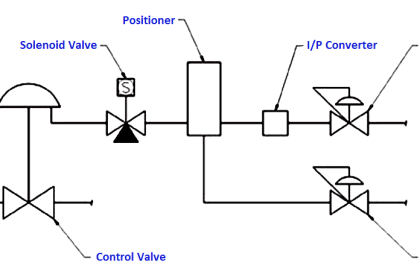
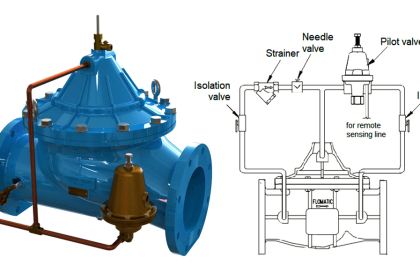
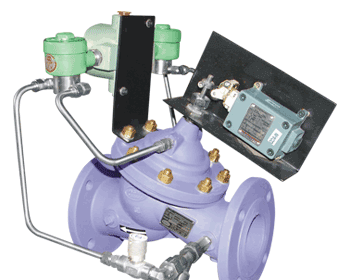
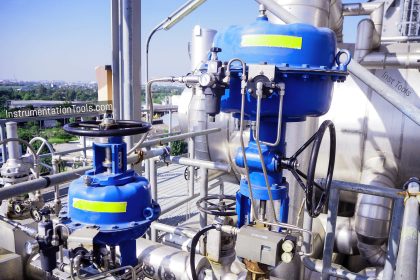
Refer to the image below. A control valve is an instrument which controls the flow of media by regulating or throttling itself. It takes the input on its suction side through a pump, compressor, regulator or any other driving device. Based on whether the valve is digital or analogue in operation, it will control the flow of media through it and output only the desired media flow at its discharge. For this reason, a control valve is a very important device in instrumentation.

The speed of the control valve is defined as actuation speed or valve response time. It is controlled by an actuator which can be pneumatic, electric or hydraulic. The speed of the actuator is thus maintained by a controller like a PLC, which can give an output of analogue or digital or even communication-based.
What is Fluid Velocity in a Pipeline?
A pipeline can allow the flow of media like liquid, gas or vapour. So, the speed at which this fluid flows through a pipe or channel is called fluid velocity. It is generally calculated through volumetric flow rate and cross-sectional area of the pipe (for liquid), pressure, temperature and gas molecular density (for gas). The velocity is usually denoted by metres per second or m/s.
Now that we are clear with the concept of fluid velocity and control valve, we will next see how they both are related to each other.
How does the Output Velocity of the Media Affect the Control Valve?
Every control valve is selected in an application based on the corresponding speed of the media flow. If everything is proper, then the fluid will flow properly in a pipeline through the control valve. Now, we will see three cases where your system performance can be hampered if any of these two go outside their parameters.
- In the first case, suppose that the control valve is chosen properly according to the design but the media velocity is higher than its rated standard. A very high velocity can erode the internal and delicate parts of the valve like plug and seal. It can also cause cavitation or bubbles inside the valve leading to its damage. The discharge pipeline of the valve is designed to allow only the desired flow, and such a high velocity can cause abrasion or erosion in the pipes. In short, the mechanical stress on valves and pipelines increases so much that it can mis-alignment, wear and tear, and eventually failure of such.
- In the second case, suppose that the control valve is chosen properly according to the design but the media velocity is lower than it’s rated standard. As the speed is low, now it means that the fluid does not have enough capacity to carry itself through the pipeline. Due to this, the impurities in the fluid can start to accumulate around the valve area over a period of time, resulting in frequent clogging. Also, as the speed is low and if your control valve is analogue in nature, it will mostly remain open in its minimum position. This under utilises your valve operation and results in a poor range working or a very bad response.
- In the third case, suppose that the control valve is not chosen properly according to the design but the media velocity is proper as per it’s rated standard. If the outlet area of the valve is smaller than its design, then the flow will become faster. In the same reverse way, if the area is larger, then the velocity will decrease. So wrong valve sizing or geometrical design or not matching the valve with existing pipe system can also cause a change in media velocity at the discharge and.
Control Valve Key Factors
The key factors to consider when choosing the correct control valve design or media flow velocity are as follows:
- Flow rate
- Flow direction
- Which is the type of fluid going to flow through the valve
- Valve capacity
- Valve working type
- Valve trim options
- Media density
- Media temperature
- Media corrosion or abrasion capabilities
- How the control valve is going to be controlled
- Maximum control valve speed
- Choosing fail safe position for the valve – fail open or fail close
- Piping size and layout design
- Upstream (incoming) and downstream (outgoing) pressure characteristics
- Media quality – clean or dirty
- Frequency of usage of the valve
As per design standards, the velocity limits of various types of media are – water as 3-5 m/s, natural gas as 60-80 m/s, compressed air as 25-55 m/s, steam up to 100 m/s and slurry as less than 4 m/s. Media velocity and control valve are thus directly related to each other. A change in the speed of flow can directly impact the system’s performance. In this way, we saw why control valve output velocity is important.
Read Next:
- Pressure Safety Valve Leak Test Procedure
- Valve Abbreviations in Engineering Drawings
- Area Velocity Flow Meter Operation Principle
- DIN Valve Connectors – Definition, Types
- Safety Relief Valve Quiz: Test Your Knowledge