Time synchronisation is a very important factor for automation systems to function correctly. This is because, if all the devices have different times in their configuration, even a slight deviation can cause time-stamped events to be logged on the server. This will confuse the engineers as to what the correct time was and which record was correct.
Synchronizing Time in Industrial Automation
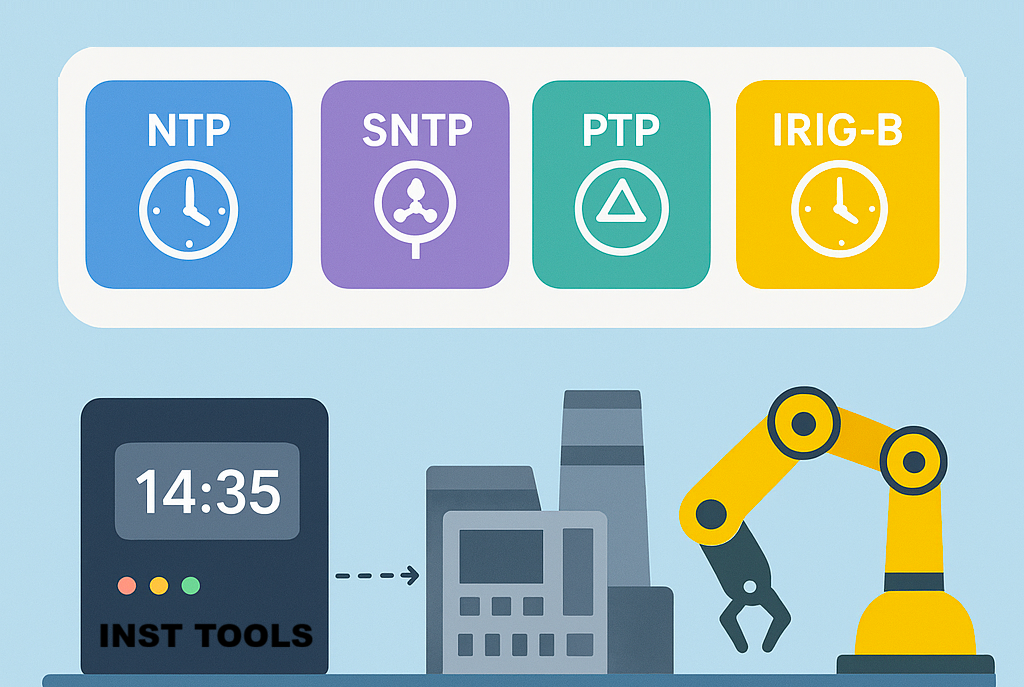
To address this, various protocols and methods are used for synchronisation of time. In this post, we will see the various ways of synchronising time in industrial automation applications.
Network Time Protocol (NTP)
NTP is the most basic and simplest version of time synchronisation used in automation systems. As the name implies, the time is synchronised between master and slave devices. The master is a server device that will have the time as a reference, and the other devices, like PLC’s, will be slaves, which are client devices. The server updates in real time continuously in sync with its feed, and the clients will update their times according to this by asking it in regular intervals. Due to this, all the devices on the network will remain at the same time.
A time server can be a Windows server, a GPS time synchronisation unit, a PLC, or a router. It gets the time from GPS satellites or internet time servers. And the network used is Ethernet. The level of distribution of time from server to client is referred to as the stratum level, ranging from stratum 0 to stratum 3.
Simple Network Time Protocol (SNTP)
It is a basic version of NTP. The work is the same, with the differences being as follows:
- It is simple to operate as it performs no network delay calculations. Meaning, the NTP calculates complex network delays internally and then comes to a conclusion that this is the final time. But in SNTP, it will just tell all the clients that this is the final time it has. So, it is not accurate and thus used only for very small applications.
- Accuracy in NTP is a maximum of 10 ms, whereas in SNTP, it is a maximum of 50 ms.
Precision time protocol (PTP)
PTP also works similarly to NTP, but is the fastest of all. As the name implies, its accuracy is only around 1 millisecond. Here, the master sends a timestamp to all the slaves on the network in continuous intervals, instead of waiting for the slave to ask, as in NTP, which it does periodically.
Due to this, the slave can keep a real-time clock while considering network delays, and adjust its clock accordingly with a very minute or negligible offset. The main thing to note is that to achieve such high accuracy, special Ethernet switches like PTP-capable switches or NICs are required. This makes PTP the fastest of all.
As these three are the most commonly used time synchronisation protocols, let us understand, with a simple example, how it works practically.
In an industrial plant, you have the following devices:
- SCADA server,
- 3 PLCs,
- 1 HMI,
- 1 Industrial managed switch,
- 1 GPS time source (optional but common in plants).
The SCADA server will be the master, which continuously gets time from a GPS time source and is thus in sync. The PLC’s and HMIs will be the clients, who get the time from the server through a network connected by an industrial managed switch.
The GPS clock provides accurate time (UTC), and the SCADA server becomes the main server in the plant. PLCs & HMIs are configured as clients, and every few minutes or seconds, each client asks for time. The SCADA server will reply with the correct time. Each client will then adjust its time accordingly. After this step, all the devices on the network will now have the same time synchronised throughout
Mostly, all the clients have built-in features to configure time synchronisation features in them. For information, a GPS-based time server is the best option if you want a very accurate time inside your plant, which will then sync the master for real-time feeding. So, depending on your application and the accuracy required, the necessary protocol is chosen. In this way, we saw what are the various ways of synchronising time in industrial automation applications.