In a control system of an industrial automation plant, there are many processes that need to be considered when you are giving FAT to a customer, dispatching your system to the customer’s place, and then commissioning it. The engineers must know all the steps so that they can properly hand over a system to the customer. In that, the three processes that are used are IQ, OQ, and PQ. These three have vast differences and must be understood clearly, as they are a part of the commissioning stage.
What is IQ in control systems?
IQ stands for installation qualification. As the name implies, this process is used to verify that the system has been installed correctly as per the requirements. Industrial automation has a wide variety of systems, ranging from electrical panels to instrumentation to automation programming. That is why the customer needs to verify this in the very first step. This is done to ensure that the system has a valid foundation, all the configurations are accurate, the utilities are correct, and there are no missing components.
IQ covers the following aspects:
- When a machine first arrives at the site, the customer needs to check whether it is aligned and placed properly as per the design specification. Mostly, this covers all the mechanical, electrical, and instrumentation parts in the placement and alignment of components.
- The engineer who came to the site and the customer must then verify that the basic utilities of power, steam, water, and air have been arranged and supplied properly to the system as per the requirements.
- Then, all the electrical wiring and connections will be checked from the field termination. It ensures that the correct voltage and frequency are applied, and the earthing is proper.
- From software and automation, it will be checked whether all the components are present as per BOM, the software version as per requirement has been installed correctly in the customer PC, the OS version of PC is correct as per requirement, network has been configured correctly with proper cabling, and care has been taken that all the necessary communication protocols have been configured correctly.
- All the manuals, wiring diagrams, P&ID, FAT & SAT reports, layout drawings, calibration certificates, and datasheets of the system have been handed over properly to the customer. This ensures that the documentation part is thorough and there is no miscommunication in that, because ultimately, these are the final things that will be referred to when any problem occurs.
What is OQ in control systems?
Once the system has been verified to be installed correctly, the next step is to verify whether it is operating properly or not. This is called OQ or operational qualification. As the name implies, this process is used to verify that the system is operating correctly as per the requirement, so that all the functions are verified, PLC logic and graphics are verified, instrument performance is tested, safety interlocks are verified, and communication tests are verified.
OQ covers the following aspects:
- The functional testing of all the components is done to see that there is no lag in the response, the speed of operation is verified, devices are turning on and off as per the logic, instruments are sensing the parameters correctly and giving the required output, and the logic is performing in sequence with the required interlocks and graphical displays shown accordingly.
- All the PLC IOs are checked, communication is tested, graphics screens are checked for system operation and response time when any value is entered, alarms and events are checked, user access levels, audit trail, data integrity, and backup-restore functions are verified, and trends and reports are verified.
- All the interlocks of the system are checked and verified to see whether they are stopping the process on time and preventing it from starting further. This, once done, proves that there are no safety risks in the system.
What is PQ in control systems?
Once OQ is done and it is verified that the system can now operate properly, it is put to the test under real-time conditions. This is known as PQ, which stands for performance qualification. Under real-time conditions, the system is checked for a few days to see whether it is actually giving the desired output consistently, whether it can withstand the outside environmental changes, and, where it is required, to see how it is performing when the input is actually raw material and not tested on simulation.
PQ covers the following aspects:
- PQ is done with actual raw material, actual product, actual operators, and actual environment exposure. The system is run either for a couple of batches or for a few days, based on the application.
- Due to this, the repeatability and reproducibility are checked to give accurate results every time, and also to understand what the rejection or defect ratio is.
- The system is tested with minimum load, normal load, and maximum load. Also, they are subjected to real environment exposure to see whether it is affected or not. At the same time, after this, the results derived in OQ are compared to see whether the system is giving the desired output as per the documents and validation results.
- Operator activities are checked to see whether the comfortable operating the system. Also, when they operate the system, the actual amount of raw material usage and utility usage is calculated.
IQ vs OQ vs PQ in control systems
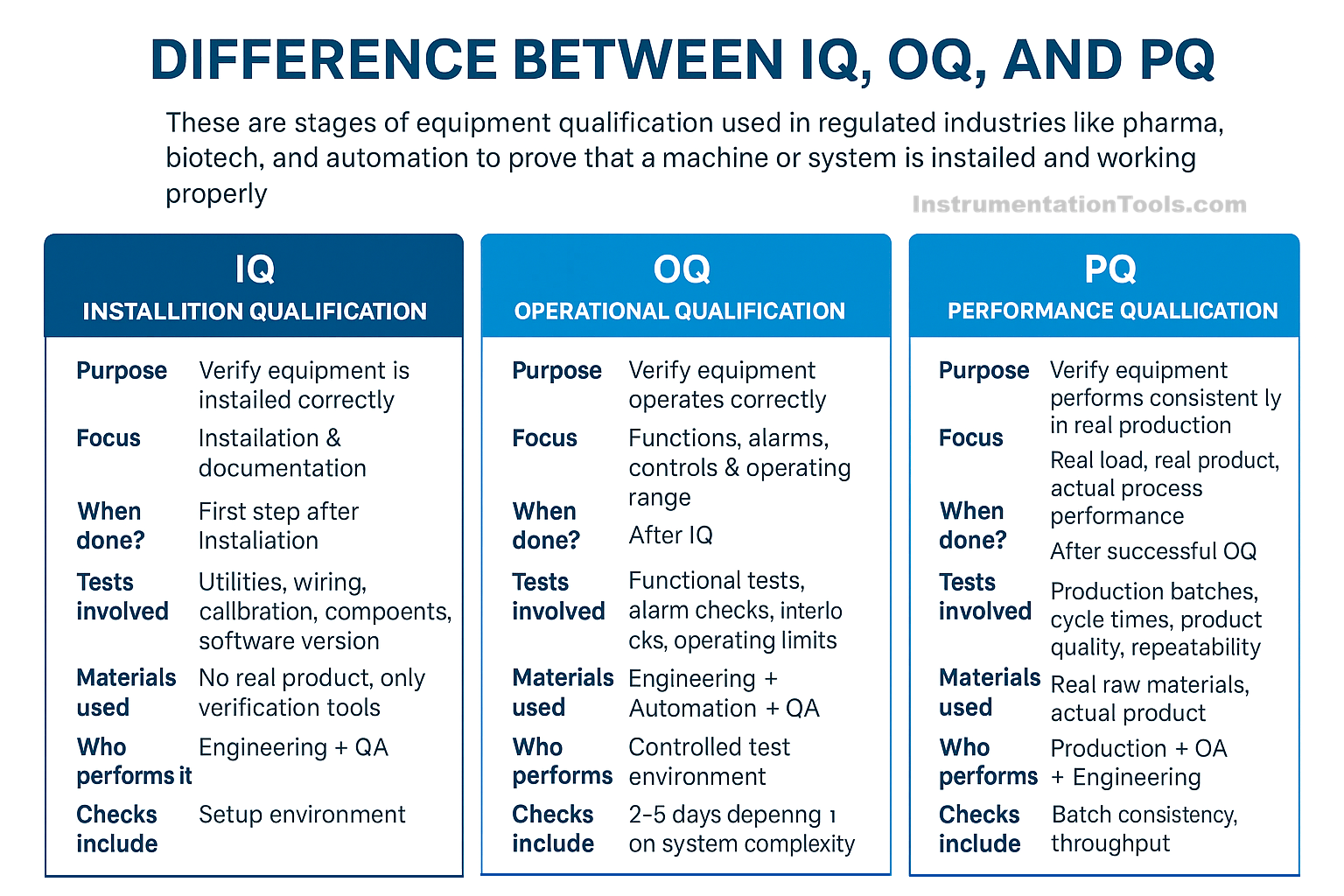
- When IQ is tested, we get to know that the system has been installed properly. When OQ is tested, we get to know that the system is operating properly. When PQ is tested, we get to know that the system is working properly under real-time conditions and is now fit to run for actual use.
- IQ only checks whether the equipment is present and installed properly as per the design requirement. OQ only checks the functionality, operating ranges, operating logic, safety interlocks, alarms, trends, and reports. PQ only checks performance, consistency, real production, and user requirements.
- First, IQ is performed, followed by OQ and then PQ.
- IQ is performed by engineering and QA, OQ is performed by engineering, automation, and QA, and PQ is performed by production, QA, and engineering.
- IQ is performed quickly, followed by OQ, and the longest time is taken by PQ.