Ethernet data communication is the most widely used form of networking in today’s industrial world. Virtually, there is still no mode of communication that is as fast, simple, and efficient as Ethernet. But a large amount of data is also handled today with the vast amount of network, which leads to data loading, loss, or network delays. Due to this, it is thus required that there must be some mechanism to synchronise data for all the devices through Ethernet. This is done lately through a proven and master technology called TSN (time sensitive network). In this post, we will see the concept of time-sensitive networking in industrial networks.
Why is TSN required in place of traditional Ethernet?
Though Ethernet is the fastest mode of communication used in industries, it is still non-deterministic. That means the data packets can arrive at unexpected times due to delays caused by loading. This means that, for example, if you are communicating two PLC’s with the first one as master and the other one as slave, then either the data from the master will reach the slave on time, or it will reach 10 milliseconds late, or it will reach even 20 milliseconds late sometimes (though not frequently). Such small data lags are acceptable in non-critical applications, but in critical applications like machine automation, where even a slight delay can affect the whole process, this lag is not acceptable.
This happens because traditional Ethernet communication works on a first-come, first-served basis. Due to this, it does not know which message is important and which is not. So in this case, there are high chances that an important message can get stuck behind unimportant ones. Data packets can collide or wait unnecessarily. It is also possible that if an unimportant message is big in size and an important message is small in size, then the unimportant one will consume the bandwidth and will be transmitted first.
All this is because the core design of Ethernet itself is event-based in nature. That is why, in applications where data lags or important messages are being sidelined, this setup will not work. For this purpose, the technology of TSN is being implemented in Ethernet for efficiently and precisely delivering each and every data properly. Let us understand the concept of TSN later in the post below.
What is time-sensitive networking?
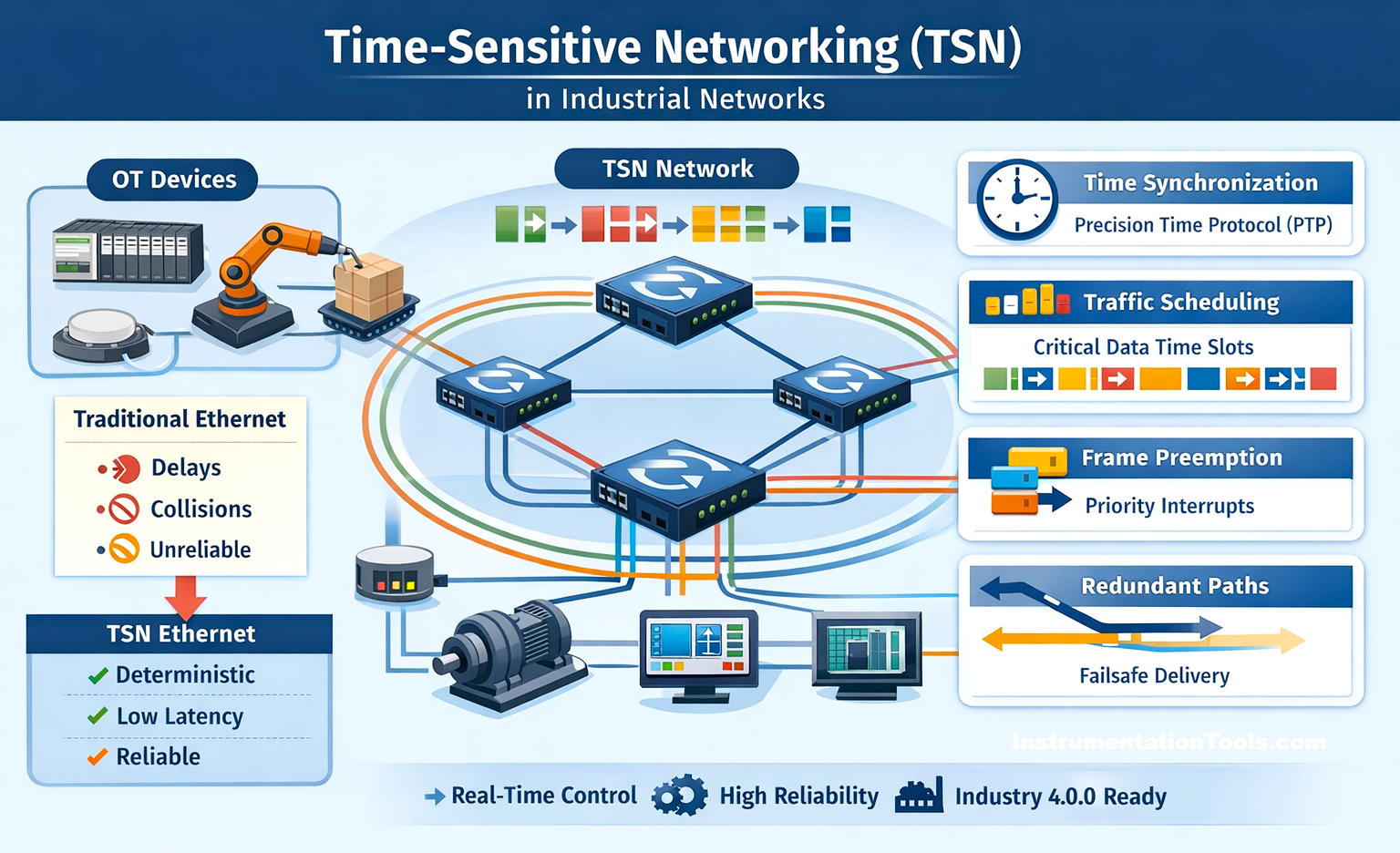
TSN, or time-sensitive networking, is a standard maintained by IEEE for providing deterministic communication over Ethernet, which is not done by traditional Ethernet. So, by the word deterministic, it means that the data packets will arrive or be sent on time in order. That is why the timely and predictable delivery of data over the Ethernet is possible. This is done through time synchronisation, where all the devices in the network synchronise clocks with perfect accuracy using precision time protocol or PTP.
This ensures that the data which will be sent or received on the network is known to all the devices with fixed timing. Time slots are assigned to critical data, which gets priority over non-critical information. That also means that such critical information can bypass the non-critical information first and reach the receiver. All the devices on the network share the same clock, which means that everyone is following a single stopwatch, and this is the main functioning of TSN.
All this is possible through PTP, or precision time protocol. In PTP, the master clock actively sends timestamp information to all slave devices at regular intervals, rather than waiting for slaves to request time updates. Because of this continuous transmission, each slave can update its internal clock in real time, accounting for network delays and adjusting itself with only a very small or negligible offset.
However, achieving this level of precision requires PTP-capable Ethernet switches and network interface cards (NICs) that can process timing information in hardware. This is why PTP provides the highest accuracy among clock-synchronization methods. Devices like Windows servers, GPS time units, PLCs, and routers can all function as time servers. They source their timing either from GPS satellites or from public internet time services. Once the correct time is obtained, it is shared across the network using standard Ethernet communication. If everyone thus knows the time precisely, we can schedule exact times when each device can send data.
In TSN, the most critical data is given the highest priority slot, followed by normal data and lower data. During a slot, only that type of traffic is allowed to move, which thus ensures no waiting, blocking, jittering, or collision. And for a normal data slot, if critical data is detected, it immediately bypasses them and reaches the receiver. Critical messages are sent twice through different paths, which is called redundancy in terms of frame replication and elimination.
TSN knows which data is critical because you explicitly tell the network which traffic is important. TSN does not guess; it works based on configuration. Critical messages are sent with a special tag called a Stream ID or Priority value, thus marking them as high priority during the configuration stage of the data device.
TSN switches have a Time-Aware Scheduler (TAS), which says which traffic is critical, when it should be allowed to pass, how much bandwidth it gets, and which time slots are reserved. This prevents low-priority traffic from interfering. TSN uses 802.1Qat/Qcc – Stream Reservation Protocol (SRP) to tell each switch along the path that real-time data is starting, which needs guaranteed bandwidth and deterministic timing reserved for it. After this, a buffer space, bandwidth, and time slot are reserved for every switch.