Industrial plants often report strange PLC faults that appear only during rainy days, monsoon season, or early-morning humidity. Sensors randomly turn ON, motors trip without command, and emergency or limit switches show false status; yet by afternoon, everything works perfectly.
PLC input failure in rain
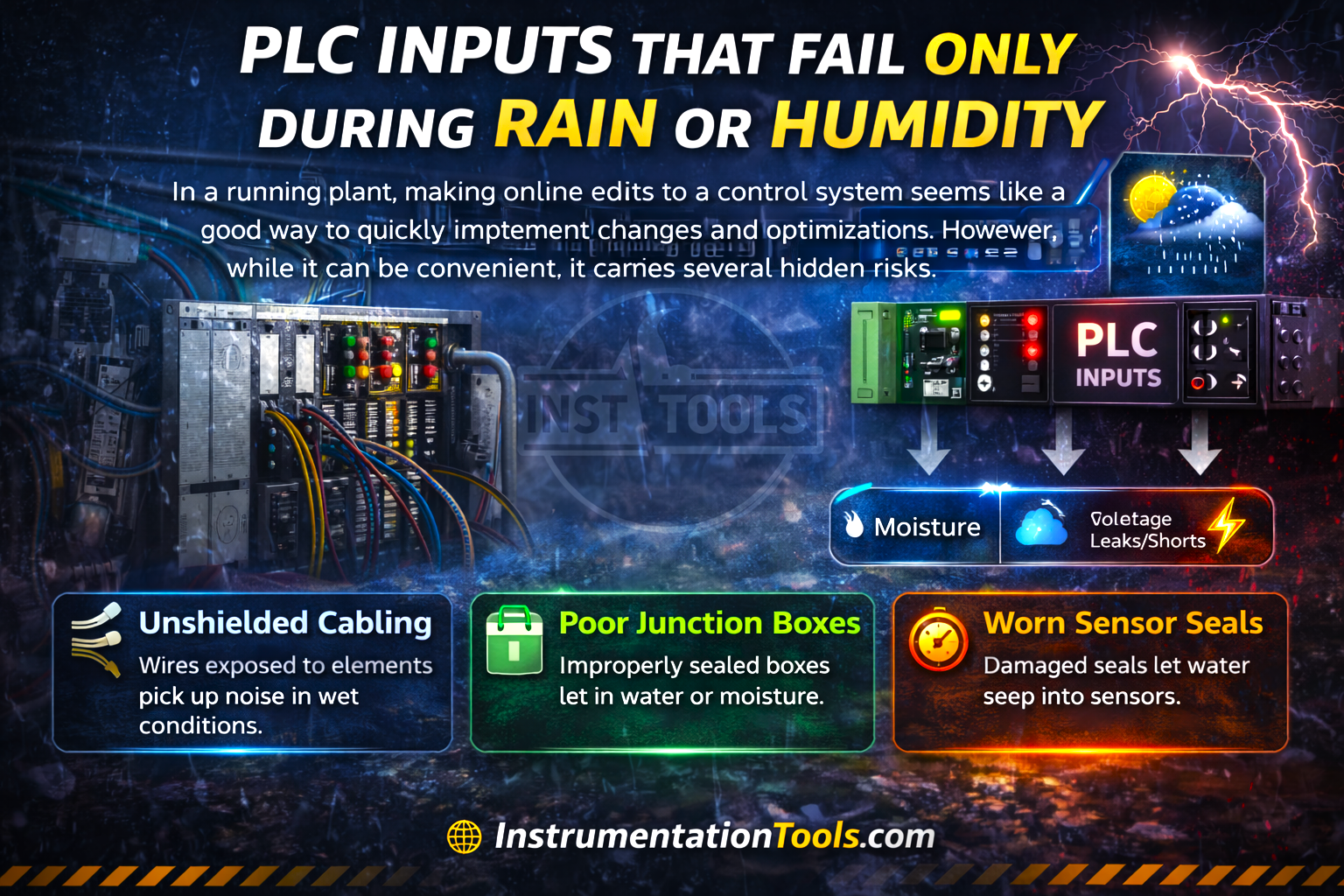
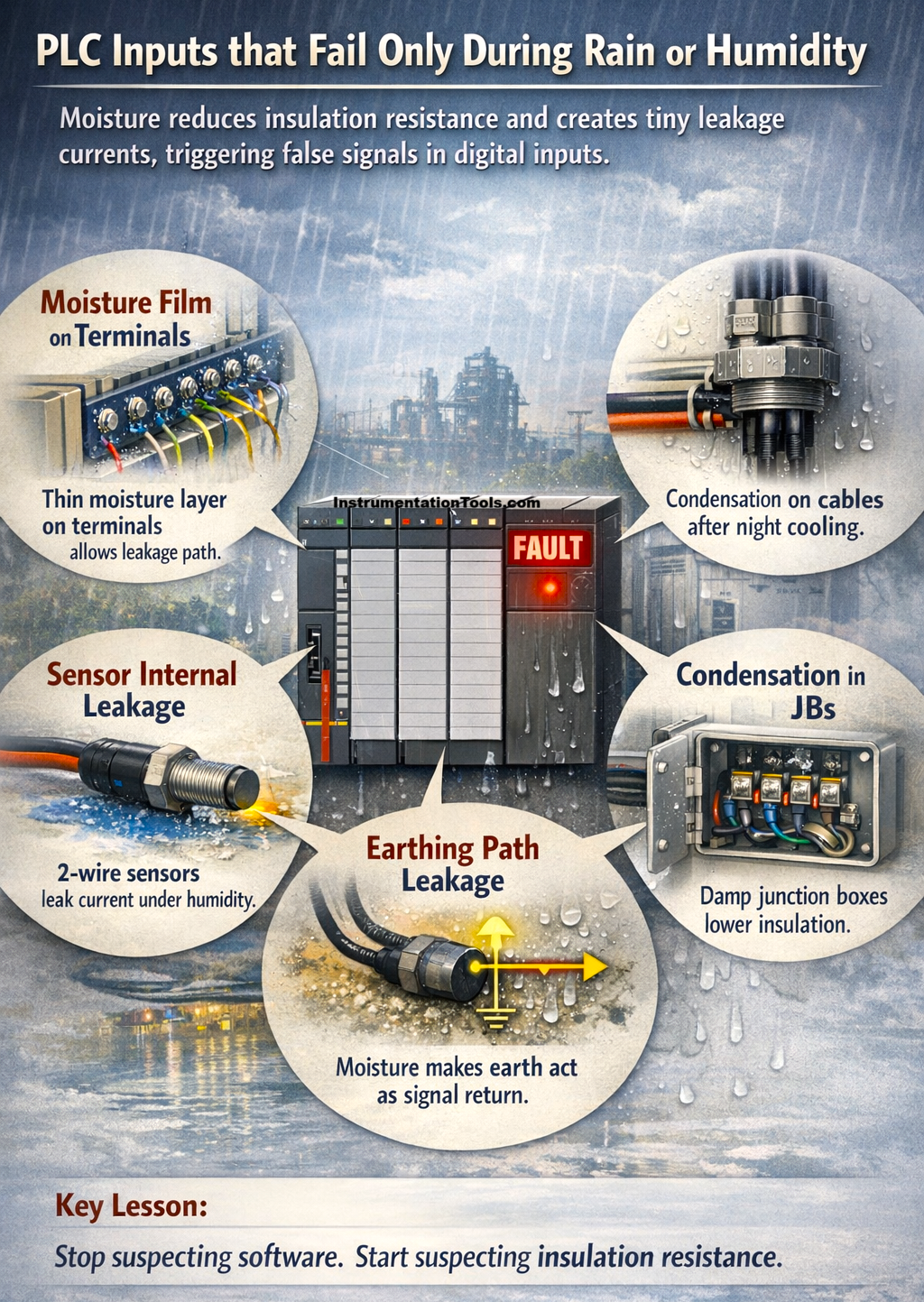
Engineers frequently suspect PLC hardware or programming errors, but the controller is rarely at fault. The real reason is environmental: moisture reduces insulation resistance and creates tiny leakage currents in field wiring. Because PLC digital inputs require very little current to activate, even these small unwanted currents can be interpreted as a valid signal, producing confusing and intermittent faults. In this post, we will see how PLC inputs fail only during rain or humidity.
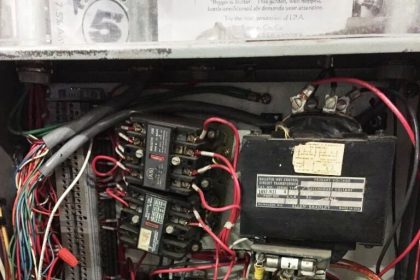
Moisture film on terminal blocks
The most common cause is not water entering the panel, but moisture settling on surfaces. During night or rainy weather, humid air inside the panel reaches the dew point. At that moment, an extremely thin, invisible layer of water forms over terminal blocks, wire ferrules, and insulation.
The panel still looks perfectly dry, so maintenance usually ignores it. However, this moisture mixes with dust, metal particles, and oil vapors already present inside the cabinet. That mixture becomes a weak conductor. Now, a tiny leakage path develops between the +24 V terminal and the PLC input terminal across the surface of the terminal strip.
A PLC digital input does not need full current like a relay coil; it only needs a few milliamps. Because PLC inputs are high-impedance circuits, even this microscopic surface current is enough to cross the ON threshold. The PLC, therefore, interprets it as a real sensor signal even though no device is actually operated.
Typically, this causes random limit switch activation, false proximity detection, or pushbuttons appearing pressed early in the morning. Once the sun rises, the panel temperature increases slightly, the moisture evaporates, the insulation resistance returns to normal, and the problem completely disappears, which is why the fault feels mysterious.
Cable glands moisture
Even a well-sealed panel can create humidity problems because the enclosure is not truly airtight. During the night, the outside temperature drops. The air trapped inside the panel cools and contracts, creating a slight negative pressure. The panel then slowly pulls humid outside air through cable glands, door rubber gaps, or conduit entries. This phenomenon is called panel breathing.
In the morning, when sunlight or nearby equipment warms the panel, the internal air heats up. Warm air cannot hold the same moisture in vapor form, so water condenses on the coolest surfaces, typically on cable insulation and near gland entry points. You will not see droplets; instead, the cable surface becomes slightly wet.
Now, a leakage path forms along the outer insulation of the cable between the 24V core and the earthed armor or gland plate. Because this leakage current is small, it does not blow a fuse or trip a supply. But for a PLC digital input, even a few milliamps is sufficient to look like a valid signal.
The input randomly turns ON, especially early morning (around 5-8 AM). By afternoon, the panel warms, condensation dries, and the input behaves perfectly normal again. This is why technicians often cannot reproduce the fault when they arrive during the daytime, and the problem literally disappears with temperature.
Sensor internal leakage
Many field sensors, especially 2-wire inductive proximity sensors and some photoelectric sensors, are not electrically open when OFF. Internally, they still need a small operating current to power their electronics, so a tiny current continuously flows through the output wire. Under normal dry conditions, this leakage current is below the PLC input activation level, so the input remains OFF.
During humid or rainy weather, the insulation resistance of the sensor cable and connector reduces. Moisture around the connector, moulded cable, or sensor body provides an additional path for current to pass. Now the small internal leakage combines with surface leakage, and the current increases just enough to cross the PLC input threshold.
The PLC, therefore, detects a valid signal even though the target is not present. This produces a very confusing symptom: the sensor LED appears OFF, but the PLC input shows ON. Maintenance often replaces the PLC card or rewires the input, yet the issue persists.
The real problem is the sensor’s leakage behavior under moisture. It is especially common with aging sensors, low-cost models, or sensors installed outdoors, near washdown areas, cooling towers, or chemical fumes, where connectors slowly degrade over time.
Junction boxes with microscopic condensation
Field junction boxes are another hidden source of humidity faults. When you open the JB, it usually looks completely dry with no water, no droplets, so it gets ruled out. But during humid nights, the metal body of the junction box cools faster than the surrounding air. Moisture in the air then condenses as a microscopic film on terminals, screw heads, and cable lugs. It is too thin to see, yet electrically significant.
Over time, this moisture reacts with oxygen and contaminants to form slight oxidation on terminals. The insulation resistance between adjacent terminals, or between a terminal and the earthed box body, drops from mega-ohms to kilo-ohms. That is still a very high resistance for power circuits, but for a PLC digital input, it is enough to allow a small current to flow into the input channel.
As a result, devices like float switches, limit switches, or field pushbuttons begin giving false status, especially early morning or during monsoon weeks. Safety chains such as E-stops are particularly affected because they run long distances through multiple JBs. By late morning, the heat dries the box, and the fault disappears, making technicians suspect loose wiring when in reality the cause is condensation inside the junction box.
The earthing path acts as an unintended signal return
In dry conditions, the earth system only carries fault current. But during rain or high humidity, moisture creates partial conductive paths between signal wires and grounded metal parts like gland plates, cable trays, or panel bodies. Now, Earth unintentionally becomes a parallel return path for small currents.
Suppose a 24V signal wire has slight insulation leakage due to moisture. That current may not return through the intended COM terminal; instead, it finds a path through damp insulation to the earthed structure. Because PLC digital inputs detect voltage relative to common, even a partial voltage (for example, 8-15V) appearing at the input terminal can be enough to cross the ON threshold.
This creates one of the most confusing field symptoms: when you measure the inactive input wire with a multimeter, you see 10-12V present, even though no device is actuated. Engineers often suspect backfeeding from the PLC input card. In reality, it is moisture-induced leakage using the earthing network as a return path. Once the humidity drops and insulation resistance improves, the phantom voltage disappears, and so does the false input signal.