In industrial automation systems, apart from local inputs and outputs, remote IO is also widely used for extending the reliability and efficiency of the system. When we commission such systems, and they have been running for many years now, there are still many causes that can affect the remote IO to fail.
Failure Modes in Remote IO Systems
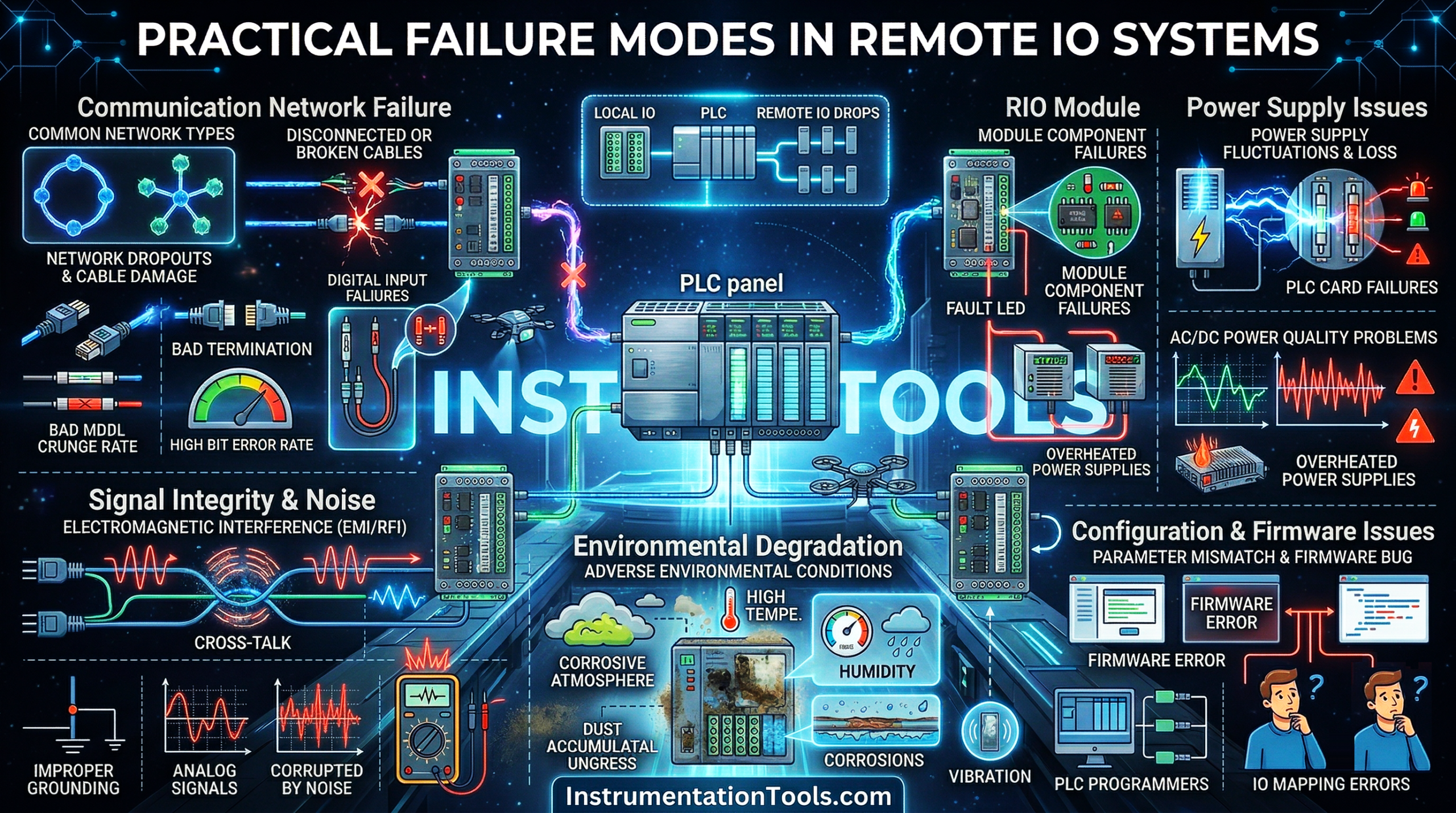
So these causes and failure modes must be understood by the engineers to troubleshoot them. In this post, we will see practical failure modes in remote IO systems.
Network communication loss in remote IO systems
This is a very basic issue that happens in a remote iOS system as time passes. All the inputs and outputs of the remote system are passed through a network protocol like EthernetIP, PROFINET, Modbus TCP/IP, etc. Over the years, the cables can catch noise due to them running nearby power cables, RJ45 connectors loosened by vibration, switch rebooting due to power supply fluctuations, or RPI (request packet interval) working too aggressively, which causes timeouts.
Due to this, the remote adapter will stop exchanging data when communication drops, or the PLC sees a timeout, or the module will be declared as inhibited if communication does not resume. Depending on the communication loss configuration, the values will be either held at the last value or reset to zero. Such failures then become dangerous for the operation of the process if network health monitoring logic is not written properly inside the program.
Power supply issues at the remote IO station
It is not necessary that the remote IO station always gets a stable power supply. The main issue comes with the power supply quantity. Mostly, the CPU has redundancy in power supply, whereas remote IO stations do not. Due to this, the very first issue comes when the power supply fails for any reason. Power supply output voltage also dips under load or reduces capacity over a time period due to the stress of temperature.
As electrical devices become old, they gradually start to consume more current or power, which dips the control voltage in the panel. And one more common reason is that the plant runs are unstable or improper grounding references, which can get disrupted over a period of time. Due to such an improper power supply, the remote IO powering up gets affected and ultimately results in failed communication.
Environmental effects on remote IO during running operation
As remote IOs are mostly placed in areas where human intervention is limited and mostly in the field, they are most affected by external environmental conditions. It can be affected by temperature, poor ventilation, direct sunlight, vibration from nearby large equipment, moisture, humidity, dust, oil, and chemical vapour.
Due to this, many issues occur as time passes, like drifting of electronic components, increasing terminal resistance, gradual loosening of terminals, inputs flickering only at night or early morning due to condensation, insulation breakdown, reduced heat dissipation, and increased leakage current. So, for running plants, the environment is an active failure source that mostly affects all the remote IO systems.
Ignoring diagnostics in running conditions
This is a purely design-type fault done from the programmer’s end. Mostly all the remote IO adapters provide connection status bits, module health flags, channel fault indicators, and time-outs. But, if the status of these conditions is never read or read only for monitoring and no control, they can result in bad failure conditions.
That is why a remote system is completely useless without proper use of diagnostic and status bits. This is not intentional, but the programmer just assumes that if he does not get the input or the output does not operate in a certain time period, then there must be some fault in the channel. But, it does not always happen due to a channel or module fault, and is also affected by other conditions, which makes the system dangerous to operate.
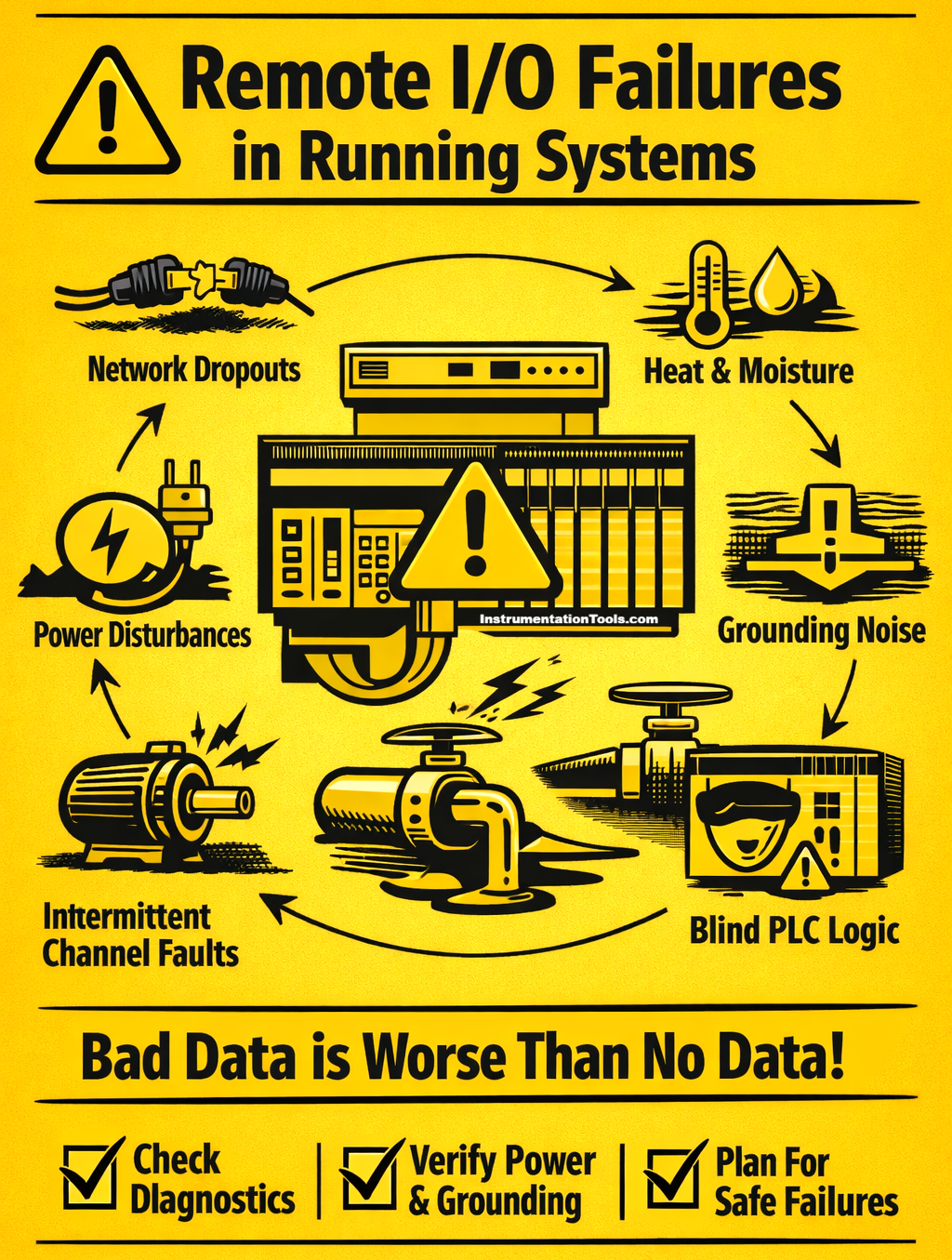
Remote I/O failures during running operation are rarely sudden or obvious; they are usually subtle, intermittent, and rooted in real-world conditions like network disturbances, power quality issues, environmental stress, grounding problems, and unnoticed channel-level faults. The most dangerous situations arise when the PLC logic continues to act on stale or incorrect data without recognizing that the I/O health has degraded.
A “healthy” remote rack does not guarantee reliable signals. Robust remote I/O systems are achieved not only through good hardware selection, but through disciplined installation, stable power and grounding practices, and diagnostic-aware PLC logic that detects, alarms, and safely reacts to abnormal conditions before they turn into process or safety incidents. In this way, we saw practical failure modes in remote IO systems.