Night-shift commissioning sounds calm and productive, with fewer meetings, less interference, and a quiet plant floor. But in reality, it is a completely different battlefield compared to the day commissioning. Technical support is limited, utilities behave differently, manpower is reduced, and your own mental sharpness is tested around 3 AM.
Night Commissioning
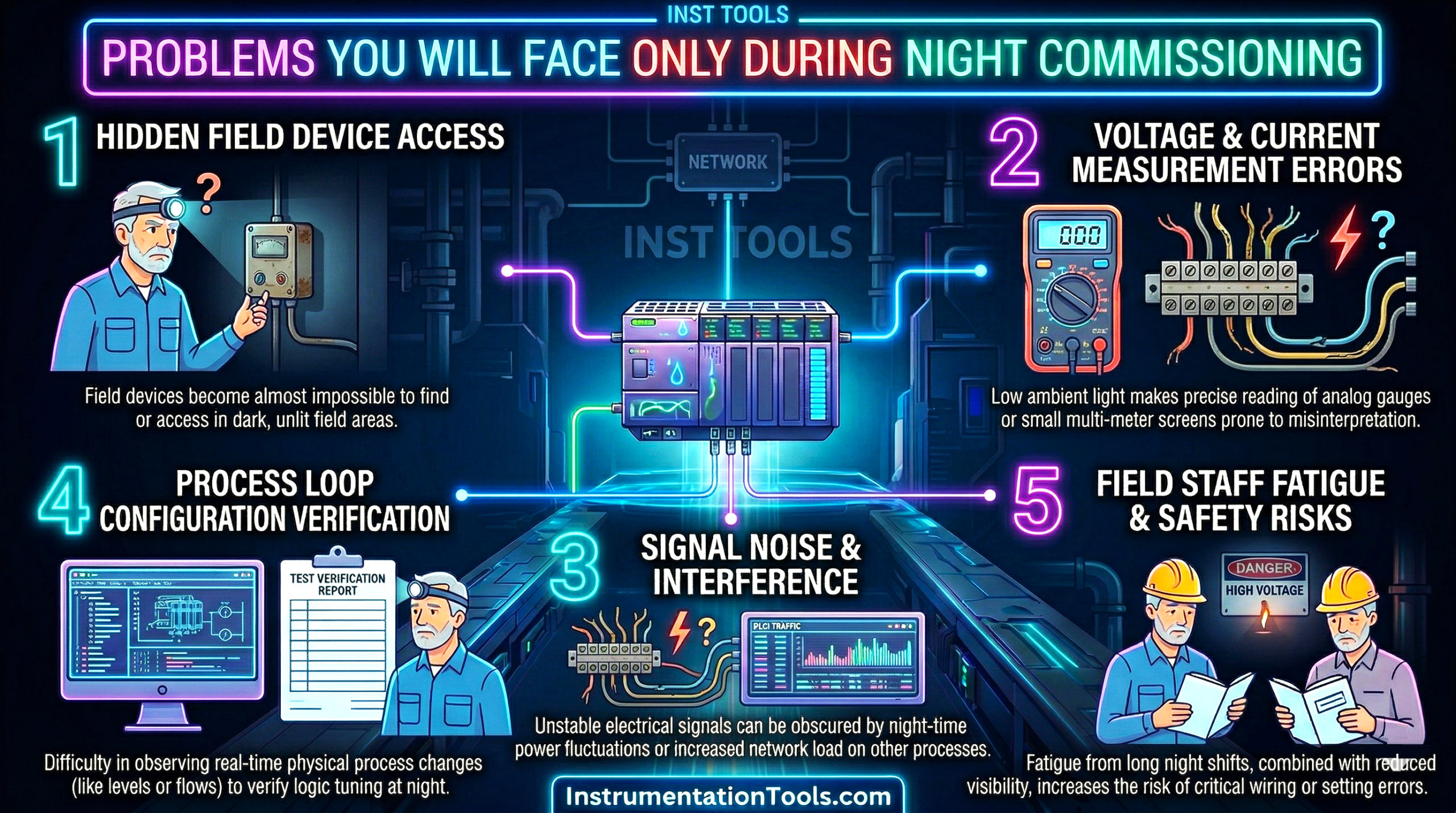
Small issues that would be solved in minutes during the day can stretch into hours at night. The silence of the plant often hides unstable power, loose signals, incomplete documentation, and communication gaps between shifts. Night commissioning doesn’t just test your PLC logic, but it tests your patience, alertness, and troubleshooting discipline, which will be seen in this post.
Reduced technical support availability
One of the biggest challenges during night-shift commissioning is reduced technical support availability. During the day, if a complex issue appears in a PLC rack, a VFD, or an HMI screen, you can immediately call the OEM engineer, system integrator, or IT team for assistance. But at 2 AM, escalation becomes slow and uncertain.
If a communication fault appears in FactoryTalk View SE or a hardware diagnostic LED starts flashing on a Siemens PLC module, you are often left troubleshooting alone with manuals and past experience. Even remote support may respond late due to time zones. This delay increases downtime and pressure, forcing you to make critical diagnostic decisions independently, or sometimes without full system documentation or backup expertise readily available.
Low visibility leading to instrumentation and wiring errors
Another major issue during night commissioning is low visibility, leading to instrumentation and wiring errors. Even if the plant lighting is on, practical working visibility is never the same as daytime. While aligning proximity sensors, setting photoelectric sensors, adjusting encoder couplings, or checking valve limit switches, small misalignments can go unnoticed.
Analog loop wiring mistakes, like reversed polarity in a 4-20 mA signal or loose terminal screws, are harder to visually detect. Panel labeling may also be less clear under artificial light, increasing the risk of landing wires on the wrong terminals. These minor physical errors often appear later as logic faults or unstable feedback signals, consuming hours in debugging. During the day, another technician might quickly spot the issue. At night, you are relying heavily on your own observation accuracy, and fatigue makes that even harder.
Unstable utility conditions
Another problem that shows up mostly during night commissioning is unstable utility conditions. Many plants intentionally reduce load, switch feeders, or operate on alternate transformers during night hours. Because of this, voltage levels may fluctuate more than usual. VFDs start showing under-voltage or DC bus faults, UPS systems go into bypass, and sensitive PLC power supplies behave inconsistently.
Sometimes compressors, chillers, or boiler systems are also operating differently compared to daytime production mode. The tricky part is that these symptoms often look like programming issues, like random trips, communication drops, or intermittent I/O faults. Engineers may spend hours checking logic or network settings, only to later discover that the root cause was unstable incoming power or grounding issues. Night commissioning teaches you one hard lesson: always verify utility stability before doubting your PLC logic.
Fatigue-induced logic and troubleshooting mistakes
Another major challenge is fatigue-induced logic and troubleshooting mistakes. Between 3 AM and 5 AM, mental sharpness naturally drops. Even experienced engineers start missing small but critical details, like a timer preset entered incorrectly, a scaling block misconfigured, or an interlock condition misunderstood.
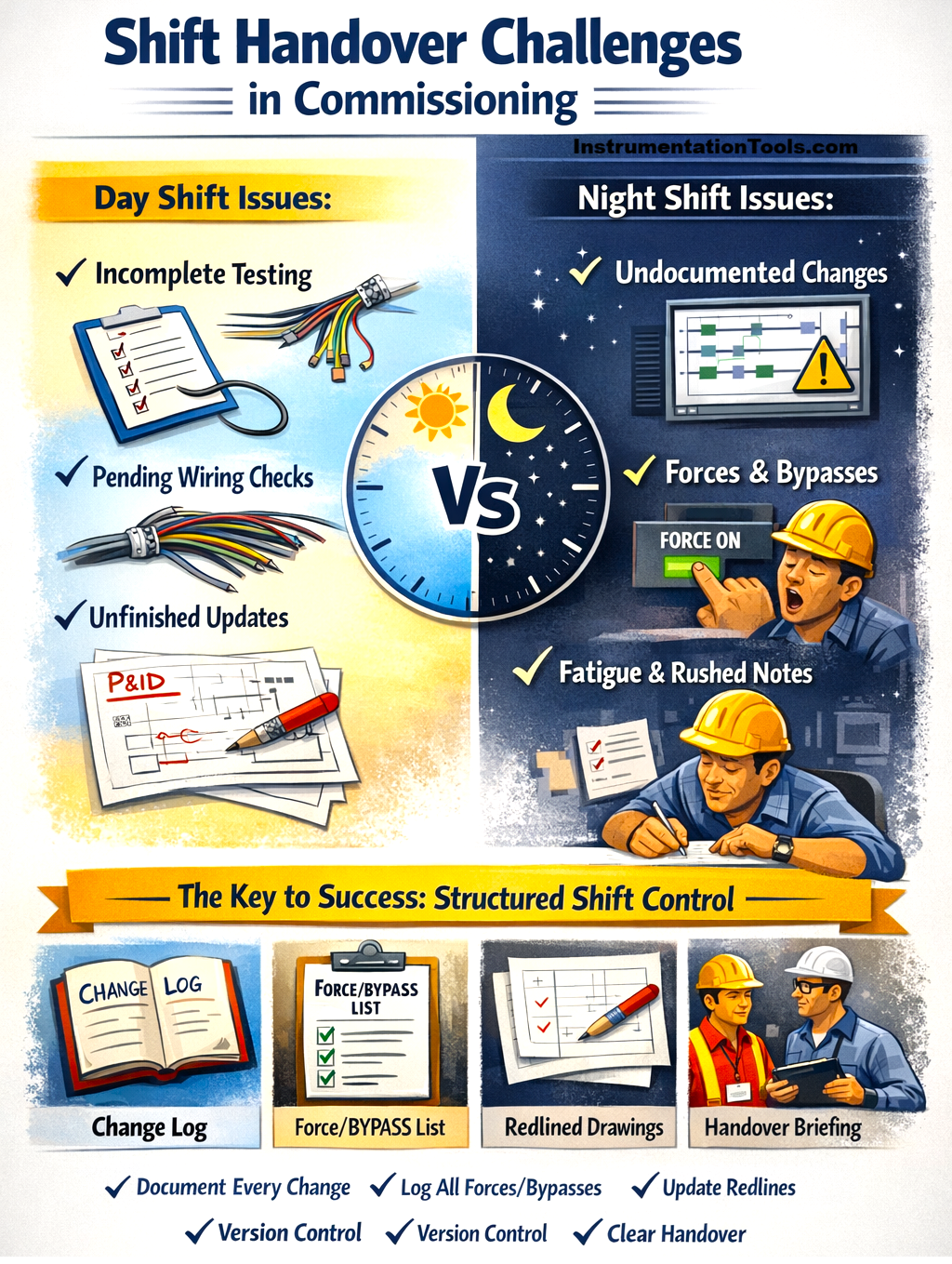
You might download the wrong PLC version, forget to remove a force, or bypass a permissive temporarily and forget to restore it. The dangerous part is that at night, there is less peer cross-checking. During day shifts, another engineer may quickly review your ladder logic or structured text and catch a mistake.
At night, you are often reviewing your own work repeatedly while fighting drowsiness. Decision-making becomes slower, and troubleshooting becomes less systematic. Night commissioning doesn’t just test your technical knowledge; it tests your mental endurance and discipline to double-verify every change before going online.
Skeleton maintenance crew effect
Another problem unique to night commissioning is the skeleton maintenance crew effect. At night, mechanical, electrical, and instrumentation teams are usually operating with minimum manpower. If a motor rotation is incorrect, a coupling is misaligned, or a valve is mechanically stuck, troubleshooting takes much longer because the right technician may not be immediately available.
For example, you may prove through PLC diagnostics that the output is healthy and the contactor is energizing, but the motor still doesn’t run due to a mechanical jam or overload trip. During the day, a mechanical supervisor would inspect it quickly. At night, you might wait 30–60 minutes just to open a gearbox or check lubrication. This delays commissioning sequences and increases pressure on the automation team, even when the root cause is purely mechanical.
Network and IT-related disruptions
Another common issue during night-shift commissioning is network and IT-related disruptions. Many plants schedule server maintenance, switch firmware updates, backups, or cybersecurity patches during night hours to avoid disturbing production. Unfortunately, that timing often clashes with commissioning activities.
You may suddenly lose communication between PLC and HMI, face intermittent Ethernet/IP drops, or see historian data gaps. Systems like WinCC Professional may freeze or disconnect due to server restarts. Managed switches may reboot after configuration changes, causing temporary I/O loss in remote racks. The confusing part is that these failures look like automation configuration issues.
Engineers start checking IP settings, subnet masks, and PLC communication blocks, only to later discover it was scheduled IT activity. Night commissioning demands extra coordination with IT teams before starting any network-dependent testing.
Increased safety risk
Another serious challenge during night commissioning is increased safety risk. At night, supervision is reduced, emergency response teams are smaller, and medical assistance may take longer to arrive. When performing dry runs, motor bump tests, conveyor trials, or interlock bypass checks, the risk level automatically increases because fewer eyes are monitoring the activity. Fatigue also plays a role in safety.
A tired engineer may forget to remove a temporary bypass, skip a lockout-tagout verification step, or stand too close during first energization. Visibility limitations and quiet surroundings can create a false sense of security, but rotating equipment, high voltage panels, and pneumatic systems remain equally dangerous.
Night commissioning requires stricter discipline in safety checklists, communication, and confirmation before energizing any equipment, because at night, mistakes have fewer immediate safety nets.