Explore key Pressure Instrumentation Questions that clarify pressure concepts for better understanding with detailed explanation and answers.
Pressure Instrumentation Questions and Answers
Question 1
Which statement correctly defines pressure?
A. Mass per unit volume
B. Force per unit area
C. Force per unit volume
D. Energy per unit area
View the Answer
Correct Answer: B. Force per unit area
Pressure is defined as the normal force acting on a surface divided by the area of that surface. Mathematically, P = F/A. Therefore, if the same force is applied over a smaller area, the resulting pressure is higher.
Question 2
Which unit is the SI unit of pressure?
A. Pascal
B. Bar
C. PSI
D. Torr
View the Answer
Correct Answer: A. Pascal
The Pascal (Pa) is the SI unit of pressure. One Pascal is equal to one Newton per square meter (N/m²). Bar, PSI, and Torr are also widely used pressure units, but they are not the SI unit for pressure.
Question 3
Which pressure is referenced to atmospheric pressure?
A. Absolute pressure
C. Gauge pressure
D. Vacuum pressure
View the Answer
Correct Answer: C. Gauge pressure
Gauge pressure is measured relative to the surrounding atmospheric pressure. If the process pressure is equal to atmospheric pressure, gauge pressure is zero. Positive gauge pressure means the process is above atmospheric pressure, while negative gauge pressure indicates pressure below atmospheric pressure.
Question 4
Which reference is used for absolute pressure measurement?
A. Atmospheric pressure
B. Perfect vacuum
C. Gauge zero
D. Process pressure
View the Answer
Correct Answer: B. Perfect vacuum
Absolute pressure uses a perfect vacuum as its theoretical zero reference. Unlike gauge pressure, it does not use atmospheric pressure as the reference. The relationship is Pabs = Pgauge + Patm.
Question 5
Which pressure is caused by the weight of Earth’s atmosphere?
A. Gauge pressure
B. Static pressure
C. Differential pressure
D. Atmospheric pressure
View the Answer
Correct Answer: D. Atmospheric pressure
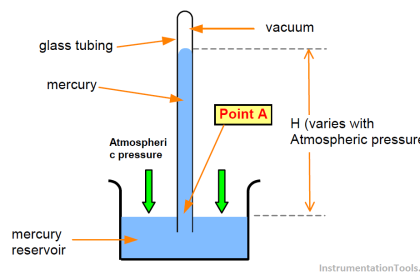
Atmospheric pressure is produced by the weight of the air column above a location. At standard sea-level conditions, atmospheric pressure is approximately 101.325 kPa absolute, or about 1.01325 bar absolute.
Question 6
A pressure transmitter referenced to atmosphere measures which pressure?
A. Absolute pressure
B. Vacuum pressure
C. Gauge pressure
D. Differential pressure
View the Answer
Correct Answer: C. Gauge pressure
A gauge-pressure transmitter uses atmospheric pressure as its reference. Its sensing element effectively compares process pressure against the atmospheric reference. Changes in atmospheric pressure can therefore affect the absolute pressure represented by a gauge measurement.
Question 7
What does a negative gauge pressure normally indicate?
A. Pressure below atmosphere
B. Pressure above atmosphere
C. Zero absolute pressure
D. High static pressure
View the Answer
Correct Answer: A. Pressure below atmosphere
Negative gauge pressure means that the process pressure is lower than atmospheric pressure. For example, a reading of −0.5 bar(g) means the absolute pressure is approximately 0.513 bar(a), assuming atmospheric pressure is about 1.013 bar(a).
Question 8
Which instrument converts process pressure into a standard electrical signal?
A. Pressure gauge
B. Pressure transmitter
C. Bourdon tube
D. Pressure switch
View the Answer
Correct Answer: B. Pressure transmitter
A pressure transmitter senses process pressure and converts it into a standardized electrical output, commonly 4–20 mA. Modern transmitters may also provide digital communication such as HART, FOUNDATION Fieldbus, or other protocols.
Question 9
Which output signal is commonly used by pressure transmitters?
A. 0–1 mA
B. 2–10 mA
C. 10–50 mA
D. 4–20 mA
View the Answer
Correct Answer: D. 4–20 mA
The 4–20 mA signal is one of the most widely used analog standards in industrial instrumentation. Typically, 4 mA represents the lower range value and 20 mA represents the upper range value. The 4 mA live zero also allows some wiring and device faults to be distinguished from a genuine zero measurement.
Question 10
Which device changes mechanical strain into resistance variation?
A. Bellows
B. Strain gauge
C. Thermistor
D. Capsule
View the Answer
Correct Answer: B. Strain gauge
A strain gauge changes its electrical resistance when mechanically stretched or compressed. In pressure transmitters, pressure-induced diaphragm deformation produces strain, and the resulting resistance change is measured electronically to determine pressure.
Question 11
Which bridge circuit is commonly used with strain gauges?
A. Wien bridge
B. Maxwell bridge
C. Wheatstone bridge
D. Schering bridge
View the Answer
Correct Answer: C. Wheatstone bridge
A Wheatstone bridge is commonly used with strain gauges because it can accurately detect very small changes in resistance. The strain gauges are arranged in bridge arms, and mechanical deformation produces an imbalance voltage proportional to the applied strain.
Question 12
What happens to a Bourdon tube when internal pressure increases?
A. It contracts completely
B. It becomes magnetic
C. It loses all elasticity
D. It tends to straighten
View the Answer
Correct Answer: D. It tends to straighten
A Bourdon tube is a curved elastic metal tube. When internal pressure increases, its cross-sectional shape changes and the tube tends to straighten. This mechanical movement is transferred through a linkage and gear mechanism to the pointer of a pressure gauge.
Question 13
Which instrument normally provides local mechanical pressure indication?
B. Pressure gauge
C. DP cell
D. Pressure switch
View the Answer
Correct Answer: B. Pressure gauge
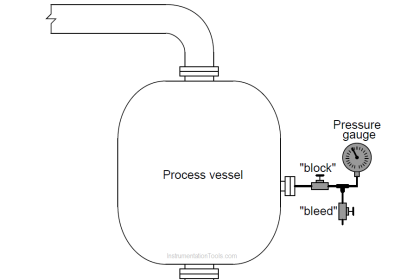
A pressure gauge provides a local indication of pressure, commonly using a Bourdon tube, diaphragm, or bellows mechanism. Unlike a transmitter, a conventional pressure gauge does not normally provide a standardized electrical output.
Question 14
Which pressure measurement requires two pressure connections?
A. Gauge pressure
B. Absolute pressure
C. Differential pressure
D. Atmospheric pressure
View the Answer
Correct Answer: C. Differential pressure
Differential pressure measurement requires two pressure inputs. The transmitter compares the pressure at the high side with the pressure at the low side and produces an output proportional to their difference: DP = PH − PL.
Question 15
What are the two pressure ports of a DP transmitter called?
A. High and Low
B. Hot and Cold
C. Input and Output
D. Supply and Return
View the Answer
Correct Answer: A. High and Low
The two process connections of a DP transmitter are normally designated H (High) and L (Low). The transmitter measures the pressure difference between these two connections. Correct connection is important because reversing them can produce an opposite or negative DP indication.
Question 16
What should a DP transmitter indicate when both ports have equal pressure?
A. Maximum DP
B. Negative DP
C. Atmospheric pressure
D. Zero DP
View the Answer
Correct Answer: D. Zero DP
When the pressure applied to the high side and low side is exactly equal, their difference is zero. Therefore, a correctly calibrated DP transmitter should indicate zero differential pressure, normally corresponding to 4 mA when the calibrated range starts at zero DP.
Question 17
Which pressure exists in a stationary fluid?
A. Static pressure
B. Dynamic pressure
C. Vacuum pressure
D. Differential pressure
View the Answer
Correct Answer: A. Static pressure
Static pressure is the pressure exerted by a fluid independent of its bulk velocity. In a completely stationary fluid, there is no dynamic component due to velocity, so the pressure is associated with the static or hydrostatic condition.
Question 18
How does hydrostatic pressure change as liquid depth increases?
A. It decreases
B. It remains constant
C. It increases
D. It becomes zero
View the Answer
Correct Answer: C. It increases
Hydrostatic pressure increases with depth because the deeper point supports a taller column of liquid above it. The relationship is P = ρgh, so pressure increases directly with liquid height when density and gravitational acceleration remain constant.
Question 19
Which equation represents hydrostatic pressure?
A. P = VI
B. P = IR
C. P = Q/A
D. P = ρgh
View the Answer
Correct Answer: D. P = ρgh
Hydrostatic pressure is calculated using P = ρgh, where ρ is fluid density, g is gravitational acceleration, and h is the vertical liquid height. This principle is fundamental to DP-based level measurement.
Question 20
In P = ρgh, what does ρ represent?
A. Fluid density
B. Fluid height
C. Gravity
D. Fluid pressure
View the Answer
Correct Answer: A. Fluid density
The symbol ρ (rho) represents fluid density, normally expressed in kg/m³. A denser liquid produces greater hydrostatic pressure for the same liquid height because the liquid column has greater mass per unit volume.
Question 21
In P = ρgh, what does h represent?
A. Fluid density
B. Fluid height
C. Fluid velocity
D. Fluid pressure
View the Answer
Correct Answer: B. Fluid height
The variable h represents the vertical height of the liquid column above the measurement point. Increasing this height increases hydrostatic pressure proportionally, assuming density and gravity remain constant.
Question 22
What happens to hydrostatic pressure when fluid density increases?
A. It decreases
B. It remains unchanged
C. It becomes zero
D. It increases
View the Answer
Correct Answer: D. It increases
From P = ρgh, pressure is directly proportional to density. Therefore, if the liquid density increases while height remains unchanged, the hydrostatic pressure also increases. This is why density variations can introduce errors in DP-based level measurement.
Question 23
Which principle is commonly used for liquid level measurement using pressure?
A. Thermal expansion
B. Hydrostatic head
C. Electrical induction
D. Radiation absorption
View the Answer
Correct Answer: B. Hydrostatic head
Hydrostatic head is the pressure generated by the weight of a liquid column. By measuring this pressure with a DP transmitter, the liquid level can be calculated when the liquid density and tank geometry are known.
Question 24
Which instrument is especially suitable for measuring small pressure differences?
A. RTD
B. Pressure gauge
C. DP transmitter
D. Thermocouple
View the Answer
Correct Answer: C. DP transmitter
A DP transmitter is specifically designed to measure pressure differences between two points. It is widely used for applications such as filter monitoring, flow measurement across an orifice, tank level measurement, and equipment pressure-drop monitoring.
Question 25
Which equation correctly relates absolute and gauge pressure?
A. Pabs = Pg − Patm
B. Pabs = Pg × Patm
C. Pabs = Pg / Patm
D. Pabs = Pg + Patm
View the Answer
Correct Answer: D. Pabs = Pg + Patm
Absolute pressure is the sum of gauge pressure and atmospheric pressure: Pabs = Pgauge + Patm. For example, 5 bar(g) at approximately 1 bar atmospheric pressure corresponds to approximately 6 bar(a).
Question 26
If gauge pressure is zero at sea level, what is absolute pressure approximately?
A. Zero
B. Atmospheric pressure
C. Perfect vacuum
D. Differential pressure
View the Answer
Correct Answer: B. Atmospheric pressure
Zero gauge pressure means the process pressure is equal to atmospheric pressure. At standard sea-level conditions, this corresponds to approximately 1.013 bar absolute, not zero absolute pressure.
Question 27
What condition corresponds to zero absolute pressure?
A. Atmospheric pressure
B. Gauge zero
C. Perfect vacuum
D. Static pressure
View the Answer
Correct Answer: C. Perfect vacuum
Zero absolute pressure is the theoretical condition of a perfect vacuum. It represents the lowest possible reference point on an absolute pressure scale.
Question 28
Which device isolates a pressure sensor from a corrosive process fluid?
A. Diaphragm seal
B. Thermowell
C. Orifice plate
D. Flow nozzle
View the Answer
Correct Answer: A. Diaphragm seal
A diaphragm seal provides a physical barrier between the process fluid and the pressure instrument. It is particularly useful for corrosive, viscous, crystallizing, sanitary, high-temperature, or plugging services.
Question 29
What is commonly used inside a diaphragm-seal system to transmit pressure?
A. Instrument air
B. Fill fluid
C. Cooling water
D. Process gas
View the Answer
Correct Answer: B. Fill fluid
A specially selected fill fluid transfers pressure from the flexible diaphragm to the pressure sensor. The fill fluid must be compatible with the application and suitable for the operating temperature.
Question 30
What is the primary function of an impulse line?
A. Supply power
B. Measure temperature
C. Generate pressure
D. Transmit process pressure
View the Answer
Correct Answer: D. Transmit process pressure
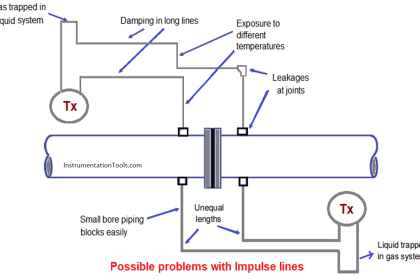
An impulse line physically connects the process tapping point to the pressure instrument. It transmits process pressure to the sensing element. Incorrect routing, blockage, leakage, or trapped gas/liquid can cause significant measurement errors.
Question 31
Which manifold is commonly used with a DP transmitter?
A. Single-valve manifold
B. Three-valve manifold
C. Temperature manifold
D. Flow manifold
View the Answer
Correct Answer: B. Three-valve manifold
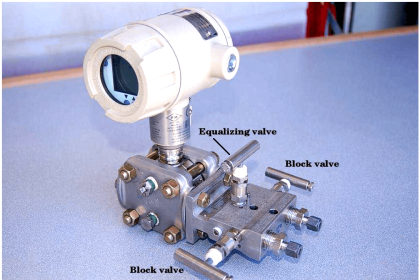
A three-valve manifold typically contains high-side isolation, low-side isolation, and an equalizing valve. It allows the transmitter to be isolated and both sides to be equalized during commissioning or maintenance.
Question 32
What is the main purpose of block valves in a transmitter manifold?
A. Measure temperature
B. Increase pressure
C. Generate DP
D. Isolate the transmitter
View the Answer
Correct Answer: D. Isolate the transmitter
Block or isolation valves allow the pressure transmitter to be separated from the process. This is essential for maintenance, calibration, troubleshooting, and safe removal of the instrument.
Question 33
Which manifold provides isolation, equalization, and venting functions?
A. Five-valve manifold
B. Two-valve manifold
C. Single valve
D. Check valve
View the Answer
Correct Answer: A. Five-valve manifold
A five-valve manifold typically provides high- and low-side isolation, an equalizing valve, and separate vent/drain functions. This arrangement is particularly useful for commissioning, calibration, and maintenance of DP transmitters.
Question 34
What is the main purpose of zero adjustment?
A. Change sensor material
B. Correct zero-point error
C. Increase maximum pressure
D. Change process connection
View the Answer
Correct Answer: B. Correct zero-point error
Zero adjustment changes the transmitter’s output relationship at the lower-range condition. It compensates for an offset so that the transmitter correctly represents the specified lower range value.
Question 35
What does span adjustment change?
A. Measurement range
B. Process temperature
C. Sensor housing
D. Cable resistance
View the Answer
Correct Answer: A. Measurement range
Span adjustment changes the difference between the lower and upper calibrated values. For example, a transmitter may be configured for 0–10 bar or 0–20 bar depending on the required application range.
Question 36
What is the span of a transmitter ranged from 0 to 10 bar?
A. 5 bar
B. 8 bar
C. 10 bar
D. 20 bar
View the Answer
Correct Answer: C. 10 bar
Span is calculated as URV − LRV. Therefore, for a 0–10 bar range, span = 10 − 0 = 10 bar.
Question 37
What is the span of a transmitter ranged from 2 to 10 bar?
A. 2 bar
B. 12 bar
C. 10 bar
D. 8 bar
View the Answer
Correct Answer: D. 8 bar
The lower range value is 2 bar and the upper range value is 10 bar. Therefore, span = 10 − 2 = 8 bar.
Question 38
What output should a 0–100 bar transmitter produce at 50 bar?
A. 8 mA
B. 12 mA
C. 16 mA
D. 20 mA
View the Answer
Correct Answer: B. 12 mA
Fifty bar represents 50% of a 0–100 bar range. For a 4–20 mA transmitter, 50% output is 4 + (0.5 × 16) = 12 mA.
Question 39
What output should a 0–10 bar transmitter produce at 5 bar?
A. 12 mA
B. 8 mA
C. 16 mA
D. 20 mA
View the Answer
Correct Answer: A. 12 mA
Five bar is 50% of the 0–10 bar range. The corresponding current is 4 mA + 50% of the 16 mA span, resulting in 12 mA.
Question 40
What output should a 0–20 bar transmitter produce at 20 bar?
A. 4 mA
B. 12 mA
C. 16 mA
D. 20 mA
View the Answer
Correct Answer: D. 20 mA
Twenty bar is the upper range value of the transmitter. Therefore, the transmitter should produce the upper standard output of 20 mA.
Question 41
What output should a 0–10 bar transmitter produce at 2.5 bar?
A. 6 mA
B. 8 mA
C. 12 mA
D. 16 mA
View the Answer
Correct Answer: B. 8 mA
2.5 bar is 25% of the measurement span. The output is therefore 4 + (0.25 × 16) = 8 mA.
Question 42
In a 0–10 bar range, what pressure corresponds to 4 mA?
A. 0 bar
B. 2.5 bar
C. 5 bar
D. 10 bar
View the Answer
Correct Answer: A. 0 bar
In a standard linear 4–20 mA transmitter, 4 mA represents the lower range value. Since the LRV is 0 bar, 4 mA corresponds to 0 bar.
Question 43
In a 0–10 bar range, what pressure corresponds to 20 mA?
A. 2.5 bar
B. 5 bar
C. 7.5 bar
D. 10 bar
View the Answer
Correct Answer: D. 10 bar
Twenty mA represents 100% of the calibrated range. Therefore, for a 0–10 bar transmitter, 20 mA corresponds to 10 bar.
Question 44
Which instrument is commonly used as a reference for pressure calibration?
A. Megger
B. Pressure calibrator
C. RTD simulator
D. Frequency meter
View the Answer
Correct Answer: B. Pressure calibrator
A pressure calibrator generates or measures a known reference pressure and is used to verify the accuracy of pressure gauges, switches, and transmitters.
Question 45
A transmitter is ranged from 20 to 120 bar. What is its span?
A. 80 bar
B. 90 bar
C. 100 bar
D. 120 bar
View the Answer
Correct Answer: C. 100 bar
The span is the difference between the upper and lower range values: 120 − 20 = 100 bar. The span is not the same as the upper range value when the LRV is above zero.
Question 46
What happens to DP when liquid level rises in an open tank?
A. It decreases
B. It remains constant
C. It increases
D. It becomes zero
View the Answer
Correct Answer: C. It increases
As the liquid level rises, the height of the liquid column above the lower pressure connection increases. This increases hydrostatic pressure and therefore increases the measured DP.
Question 47
Which sensor detects pressure through pressure-induced resistance changes?
A. Thermocouple
B. RTD
C. Piezoresistive sensor
D. Bimetal sensor
View the Answer
Correct Answer: C. Piezoresistive sensor
A piezoresistive pressure sensor uses semiconductor or resistive elements whose resistance changes when mechanical stress is applied. The pressure-induced diaphragm strain is converted into an electrical signal.
Question 48
Approximately how much pressure is represented by 1 bar?
A. 10 kPa
B. 100 kPa
C. 1000 kPa
D. 1 kPa
View the Answer
Correct Answer: B. 100 kPa
One bar is exactly 100 kPa. It is a commonly used industrial pressure unit, especially in process plants and instrumentation specifications.
Question 49
Which reference does a gauge-pressure transmitter use?
A. Perfect vacuum
B. Absolute zero
C. Reference temperature
D. Atmospheric pressure
View the Answer
Correct Answer: D. Atmospheric pressure
A gauge-pressure transmitter measures pressure relative to the local atmospheric pressure. Its zero point therefore corresponds approximately to atmospheric pressure rather than perfect vacuum.
Question 50
Which reference does an absolute-pressure transmitter use?
A. Perfect vacuum
B. Atmospheric pressure
C. Gauge pressure
D. Differential pressure
View the Answer
Correct Answer: A. Perfect vacuum
An absolute-pressure transmitter uses a vacuum reference. This allows it to measure pressure independently of variations in atmospheric pressure.
Question 51
Which application commonly uses a DP transmitter across a filter?
A. Temperature control
B. Filter blockage monitor
C. Speed measurement
D. Vibration monitoring
View the Answer
Correct Answer: B. Filter blockage monitor
A clean filter normally has a relatively low pressure drop. As the filter becomes blocked, the pressure difference across it increases. A DP transmitter can therefore provide an early indication of filter fouling or blockage.
Question 52
What is the primary purpose of a diaphragm seal?
A. Increase process pressure
B. Reduce signal noise
C. Isolate the sensor from process fluid
D. Increase transmitter range
View the Answer
Correct Answer: C. Isolate the sensor from process fluid
A diaphragm seal separates the pressure sensor from the process. It is useful where the process is corrosive, viscous, hot, sanitary, crystallizing, or otherwise unsuitable for direct connection to the sensing element.
Question 53
One Pascal is equal to which expression?
A. 1 N/m
B. 1 kg/m²
C. 1 J/m²
D. 1 N/m²
View the Answer
Correct Answer: D. 1 N/m²
The Pascal is defined as one Newton per square meter (N/m²). This definition follows directly from the pressure equation P = F/A.
Question 54
Which sensing element is widely used in pressure transmitters?
A. Float
B. Thermocouple
C. Diaphragm
D. Bimetal strip
View the Answer
Correct Answer: C. Diaphragm
The diaphragm is one of the most widely used pressure-sensing elements. Pressure causes the diaphragm to deflect, and this mechanical deformation is converted into an electrical signal by technologies such as capacitive or piezoresistive sensing.
Question 55
What does a differential pressure instrument measure?
A. Difference between two pressures
B. Absolute pressure
C. Atmospheric pressure
D. Vacuum level
View the Answer
Correct Answer: A. Difference between two pressures
A DP instrument measures the difference between two applied pressures. The fundamental relationship is DP = PH − PL, where PH is the high-side pressure and PL is the low-side pressure.
Question 56
What happens to a pressure-sensing diaphragm when pressure changes?
A. It deflects
B. It melts
C. It changes color
D. It rotates continuously
View the Answer
Correct Answer: A. It deflects
Pressure causes the diaphragm to undergo a small mechanical deflection. Depending on the transmitter technology, this movement may be detected as a change in capacitance, resistance, or another electrical parameter.
Question 57
What can a blocked pressure impulse line cause?
A. Incorrect pressure reading
B. Higher measurement accuracy
C. Increased process flow
D. Higher supply voltage
View the Answer
Correct Answer: A. Incorrect pressure reading
A blocked impulse line prevents the actual process pressure from being transmitted correctly to the sensor. The transmitter may therefore continue displaying an old, delayed, or otherwise incorrect pressure value.
Question 58
Why can trapped gas in a liquid impulse line cause error?
A. It increases signal current
B. It changes pressure transmission
C. It eliminates hydrostatic head
D. It increases density
View the Answer
Correct Answer: B. It changes pressure transmission
Gas trapped in a liquid impulse line is compressible and can interfere with the transmission of pressure. In DP level systems, incorrect liquid/gas arrangement can also create additional hydrostatic effects and measurement errors.
Question 59
Why can liquid accumulate in a gas impulse line?
A. To increase pressure range
B. To improve accuracy
C. To distort pressure transmission
D. To reduce sensor temperature
View the Answer
Correct Answer: C. To distort pressure transmission
Condensed liquid in a gas impulse line creates an additional liquid head. This extra hydrostatic pressure can be interpreted by the transmitter as process pressure and produce an incorrect reading.
Question 60
Why are impulse lines sometimes heat traced?
A. To increase pressure
B. To reduce flow
C. To increase signal current
D. To prevent freezing
View the Answer
Correct Answer: D. To prevent freezing
Heat tracing keeps the process fluid within a suitable temperature range. It is particularly important when the process fluid can freeze, crystallize, or become highly viscous at lower temperatures.
Question 61
Why are pressure impulse lines sometimes insulated?
A. To maintain process temperature
B. To increase electrical current
C. To increase pressure
D. To reduce transmitter range
View the Answer
Correct Answer: A. To maintain process temperature
Insulation reduces heat transfer between the impulse line and the surroundings. Maintaining the process-fluid temperature can prevent condensation, freezing, crystallization, or viscosity changes that could affect pressure transmission.
Question 62
What does transmitter turndown describe?
A. Sensor response time
B. Maximum pressure
C. Ratio of maximum to minimum span
D. Output current range
View the Answer
Correct Answer: C. Ratio of maximum to minimum span
Turndown ratio describes how much the calibrated span can be reduced from the transmitter’s maximum specified span while maintaining specified performance. For example, a 100:1 turndown means a transmitter designed for a 100-unit maximum span may be configured for a much smaller span within its specifications.
Question 63
Why may density compensation be required in DP level measurement?
A. Density affects hydrostatic pressure
B. Density changes cable color
C. Density increases signal voltage
D. Density eliminates atmospheric pressure
View the Answer
Correct Answer: A. Density affects hydrostatic pressure
DP level measurement is based on P = ρgh. If liquid density changes while actual level remains constant, the measured hydrostatic pressure changes. Without density compensation, the transmitter can interpret the density change as a level change.
Question 64
When is a remote seal particularly useful?
A. When pressure is zero
B. When direct process connection is unsuitable
C. When no process fluid exists
D. When transmitter power is unavailable
View the Answer
Correct Answer: B. When direct process connection is unsuitable
A remote seal is useful when the transmitter cannot be mounted directly at the process connection. Typical reasons include very high temperature, corrosive fluids, viscous or plugging fluids, difficult accessibility, or requirements for special process isolation.
Question 65
Which transmitter uses a vacuum reference for pressure measurement?
A. Absolute pressure transmitter
B. Gauge transmitter
C. DP transmitter
D. Pressure switch
View the Answer
Correct Answer: A. Absolute pressure transmitter
An absolute pressure transmitter uses a sealed vacuum reference. This means the measured value represents the actual pressure above a theoretical perfect vacuum and is not directly referenced to changing atmospheric pressure.
Question 66
What is the primary purpose of an equalizing valve?
A. Increase pressure
B. Drain process fluid
C. Equalize both pressure sides
D. Increase flow
View the Answer
Correct Answer: C. Equalize both pressure sides
The equalizing valve connects the high-pressure and low-pressure sides of a DP transmitter. Opening it equalizes both sides and protects the sensing element from excessive differential pressure during certain maintenance procedures.
Question 67
What is the main function of a pressure snubber?
A. Damp pressure fluctuations
B. Increase pressure
C. Measure temperature
D. Increase flow
View the Answer
Correct Answer: A. Damp pressure fluctuations
A pressure snubber restricts rapid pressure fluctuations reaching the instrument. It helps protect pressure gauges and transmitters from pulsating service and can improve indication stability.
Question 68
Why is a siphon used with a steam pressure gauge?
A. Increase pressure
B. Increase steam flow
C. Reduce gauge range
D. Protect the gauge from heat
View the Answer
Correct Answer: D. Protect the gauge from heat
A siphon creates a water or condensate seal between the hot steam and the pressure gauge. This prevents high-temperature steam from directly entering the gauge and protects the sensing mechanism.
Question 69
In an open tank, what primarily determines hydrostatic pressure?
A. Cable resistance
B. Liquid height and density
C. Transmitter voltage
D. Ambient temperature only
View the Answer
Correct Answer: B. Liquid height and density
Hydrostatic pressure depends on P = ρgh. Therefore, liquid density and liquid height are the primary process variables affecting the pressure at the measurement point, while gravity is normally considered constant.