ISA-95 (IEC 62264) is a globally accepted standard that provides a structured framework for integrating business-level systems (ERP) with manufacturing and automation systems (MES, PLC, SCADA). Instead of focusing on control logic, it standardises terminology, models, and information flow to ensure smooth coordination between production planning and shop-floor execution. By clearly defining system boundaries and data exchange responsibilities, ISA-95 minimises custom integrations, improves consistency across platforms, and supports better production tracking, traceability, and operational efficiency in modern manufacturing environments. In this post, we will discuss the concept of ISA-95.
What is the ISA-95 standard?
ISA-95 is an international standard used to integrate business systems with manufacturing systems in an industrial environment. Its main goal is to create a clear and consistent link between ERP systems, which focus on planning and business operations, and MES and automation systems, which execute and monitor production on the shop floor. Rather than dealing with machine control or PLC programming, ISA-95 defines common terminology, models, and system boundaries. This ensures that all systems interpret data such as orders, materials, equipment, and production results in the same way.
By standardising information exchange, ISA-95 reduces integration complexity, avoids data mismatch, and improves visibility of manufacturing operations. It helps organisations keep production planning and actual execution aligned, especially in large, multi-line or multi-site manufacturing environments. In simple terms, ISA-95 provides a common language and structure to connect ERP, MES and PLC/SCADA. It does not define control logic, but defines who talks to whom, what data is exchanged, and at which level.
Why is the ISA-95 standard important?
In a manufacturing company, different systems are used for different purposes. For example, one system is used by management to plan production and handle orders, while another system is used on the shop floor to actually run machines and track production. Earlier, these systems were developed separately and did not understand each other’s data properly.
For a fresher, imagine this situation: Management plans to produce 1,000 units in the ERP system, but the shop floor system records production in a different format or with different names. Someone then has to manually convert, correct, or re-enter this data. This leads to mistakes, delays, and confusion.
ISA-95 was created to avoid this problem. It defines who should do what and what information should be shared between systems. With ISA-95, planning systems send clear production orders, and manufacturing systems send back actual results like quantities produced, downtime, or material usage. This removes manual work, reduces errors, and helps everyone from operators to managers to see the same accurate production information.
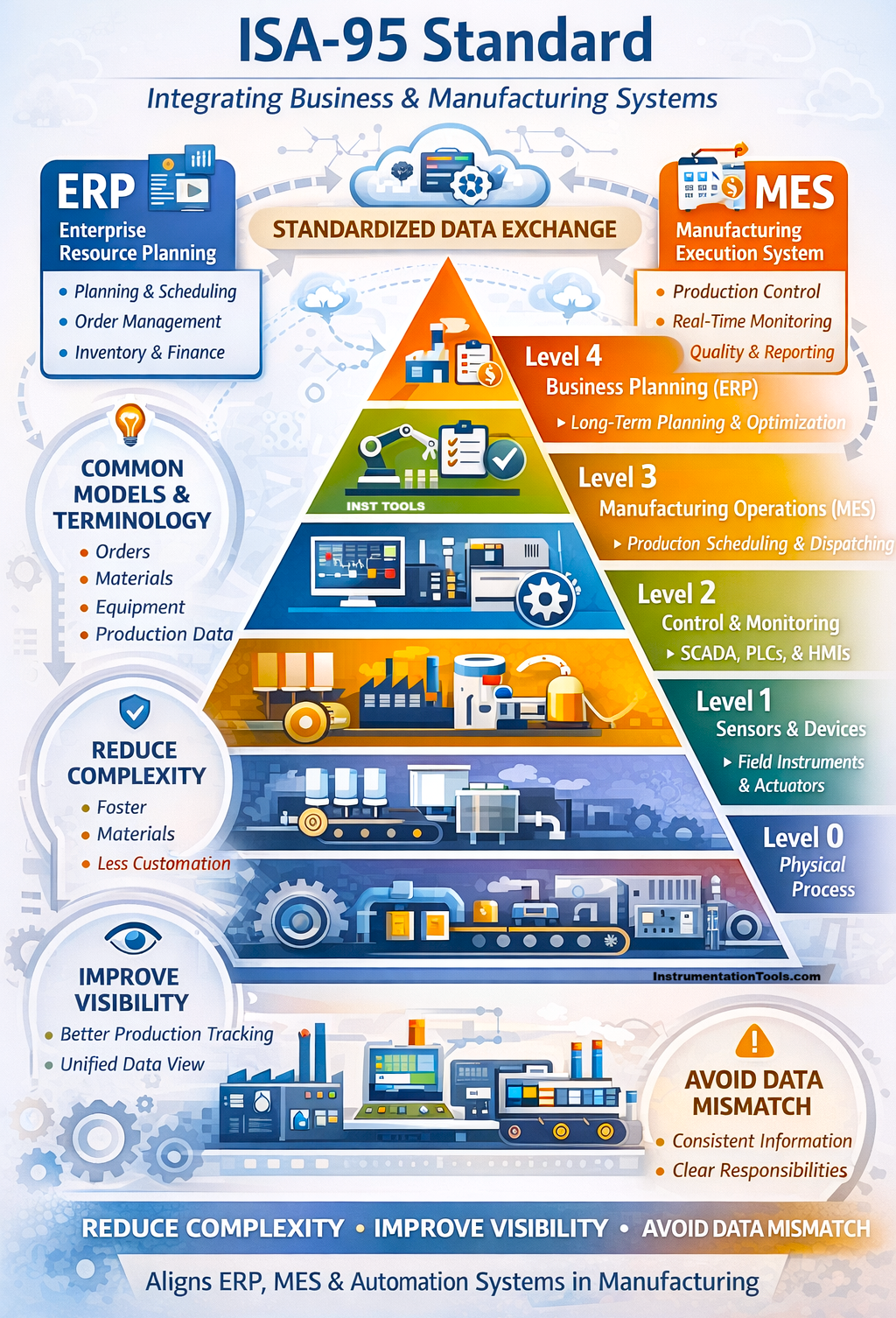
ISA-95 automation pyramid structure
The ISA-95 automation pyramid shows how a manufacturing system is structured from the shop-floor process up to business management systems. It helps explain which activities belong at which level and prevents mixing of responsibilities between control, operations, and business planning.
Level 0 – Process Execution
This level represents the actual physical process taking place in the plant. It includes actions such as heating, cooling, mixing, filling, cutting, pumping, or chemical reactions. No automation logic exists here; only the real process where raw materials are transformed into finished products.
Level 1 – Field Devices
Level 1 consists of devices that measure and act on the process. Sensors like temperature, pressure, and flow transmitters collect process data, while actuators such as valves, motors, and drives physically control the process. This level acts as the interface between the real process and the control system.
Level 2 – Control and Monitoring
At Level 2, control systems operate the plant in real time. This includes PLCs, DCS controllers, SCADA, and HMIs. Control logic, sequencing, alarms, interlocks, and operator commands are handled here. The primary focus is to keep the process running safely, efficiently, and within defined limits.
Level 3 – Manufacturing Operations Management (MES)
Level 3 manages how production is executed, rather than how machines are controlled. MES systems operate at this level, handling tasks such as scheduling production orders, tracking materials and batches, monitoring quality checks, coordinating maintenance activities, and calculating performance indicators like OEE. This layer connects business plans with actual shop-floor execution.
Operational areas at Level 3 include:
- Production management
- Quality management
- Maintenance management
- Inventory and material management
Level 4 – Business Planning Systems (ERP)
Level 4 focuses on enterprise-level planning and decision-making. ERP systems at this level manage customer orders, supply chain planning, procurement, inventory valuation, costing, and financial reporting. This layer sets production targets but does not interact directly with machines or control systems.
To newcomers to the concept of ERP and MES, let us understand the clear difference between them first before proceeding further. In the ISA-95 structure, ERP and MES serve very different but complementary roles. ERP systems operate at the business level and focus on planning and decision-making, such as managing customer orders, production schedules, material planning, procurement, and financial data. They work with long-term or mid-term timelines and are not concerned with what is happening on the shop floor at a given moment.
MES systems, on the other hand, operate at the manufacturing level and focus on executing those plans in real time. MES receives production orders from ERP and manages how production is actually carried out by tracking machine status, production quantities, material usage, quality checks, and downtime. Simply put, ERP decides what should be produced and when, while MES ensures how it is produced and reports what actually happened back to the business system.
ERP systems are not designed to communicate directly with lower automation layers such as PLCs, DCS, or field devices, and ISA-95 strongly discourages this approach. One main reason is that ERP works on business time scales of minutes, hours, days, or weeks, while lower layers operate in milliseconds and seconds. ERP systems cannot handle real-time signals, fast data changes, alarms, or control logic without performance and reliability issues. Another reason is complexity and risk.
PLCs generate thousands of tags and real-time events that change frequently. If ERP connects directly to these systems, even small changes in control logic or tag names can break the integration and impact business processes. This also increases cybersecurity risk, because exposing control networks directly to enterprise systems makes plants more vulnerable to attacks.
MES acts as a buffer and translator between ERP and the shop floor. It filters, aggregates, and contextualises real-time data into meaningful production information before sending it to ERP. By keeping ERP away from direct machine control, ISA-95 ensures stable operations, safer systems, easier maintenance, and a clean separation between business planning and real-time control.
Key ISA-95 models
ISA-95 introduces several standardised models to ensure that business systems, manufacturing systems, and automation layers describe and exchange information in a uniform manner. These models remove ambiguity and create a common understanding of plant structure, production flow, resources, and responsibilities.
Equipment Model
The equipment model defines how manufacturing assets are arranged in a logical hierarchy. It starts at the top with the Enterprise, followed by Site, Area, and Production Line or Work Centre, and then goes down to Units, Equipment Modules, and Control Modules. This structured view helps MES and ERP systems clearly identify where production takes place and which equipment is involved, while also making it easier to link PLC data to higher-level systems.
Material Model
The material model standardises how materials are described and tracked across systems. It covers raw materials, semi-finished products, finished goods, and consumables, along with material classes, batches or lots, quantities, and storage locations. This model allows accurate tracking of material usage, production output, and genealogy, ensuring consistency between shop-floor records and business inventory data.
Personnel Model
The personnel model focuses on the people involved in manufacturing operations by defining roles, responsibilities, and capabilities rather than just individuals. It includes operators, maintenance technicians, supervisors, and quality personnel. This model supports controlled access, activity logging, traceability, and compliance requirements, especially in regulated manufacturing environments.
Process Model
The process model explains the sequence of activities required to manufacture a product. It is organised into process segments, operations, and actions, providing a clear structure of how production should flow. This model is especially useful for MES execution and aligns closely with ISA-88 concepts in batch and hybrid processes.
Product Definition Model
The product definition model brings together information from materials, equipment, and processes to describe how a specific product is produced. It includes items such as BOMs, routing steps, and production rules. ERP systems use this information for planning, while MES relies on it to execute production correctly on the shop floor.
Manufacturing operations management in ISA-95
Manufacturing Operations Management (MOM) is a concept defined in ISA-95 that explains how day-to-day manufacturing work is managed on the shop floor. It sits between planning systems (ERP) and control systems (PLC/SCADA) and answers a very simple question: “Once management has planned production, how is that plan actually executed, monitored, and reported from the factory?” MOM does not control machines and does not do business accounting. Its role is to manage operations while production is running.
The simple view of MOM is:
- ERP decides what to produce and when
- MOM (MES layer) decides how production will be executed today or now
- PLC/SCADA actually runs the machines
MOM converts business plans into actionable instructions for the shop floor and converts shop-floor data into useful information for management.
ISA-95 divides MOM into four clear operational areas, so that nothing overlaps or gets confused.
1. Production Operations Management
This part manages actual production execution.
It answers questions like:
- Which order is running on which line?
- How much is produced right now?
- Are we meeting the plan or falling behind?
Typical activities include:
- Receiving production orders from ERP
- Assigning orders to machines or lines
- Tracking start, stop, and completion of jobs
- Recording actual production quantities
- Capturing downtime reasons and production losses
In simple terms, production operations ensure that planned production is actually happening.
2. Quality Operations Management
This part manages product quality during manufacturing, not after everything is finished.
It answers questions like:
- Is the product meeting quality requirements?
- Were inspections done on time?
- What defects or deviations occurred?
Typical activities include:
- Defining inspection steps
- Recording test and measurement results
- Handling non-conforming products
- Maintaining quality and compliance records
In simple terms, quality operations ensure that production output is acceptable and traceable.
3. Maintenance Operations Management
This part manages equipment health and availability.
It answers questions like:
- Is the machine healthy or faulty?
- When should maintenance be performed?
- Why did a breakdown occur?
Typical activities include:
- Tracking machine status (running, stopped, faulted)
- Managing preventive and corrective maintenance tasks
- Recording breakdown history
- Coordinating maintenance with production schedules
In simple terms, maintenance operations ensure machines are available and reliable.
4. Inventory Operations Management
This part manages materials inside the factory, not warehouse finance.
It answers questions like:
- Which material lot was used?
- How much material was consumed?
- Where is the work-in-progress right now?
Typical activities include:
- Tracking raw materials, WIP, and finished goods
- Recording material movements
- Managing batch and lot genealogy
- Reporting material consumption back to ERP
In simple terms, inventory operations ensure the right material is used at the right time and tracked properly.
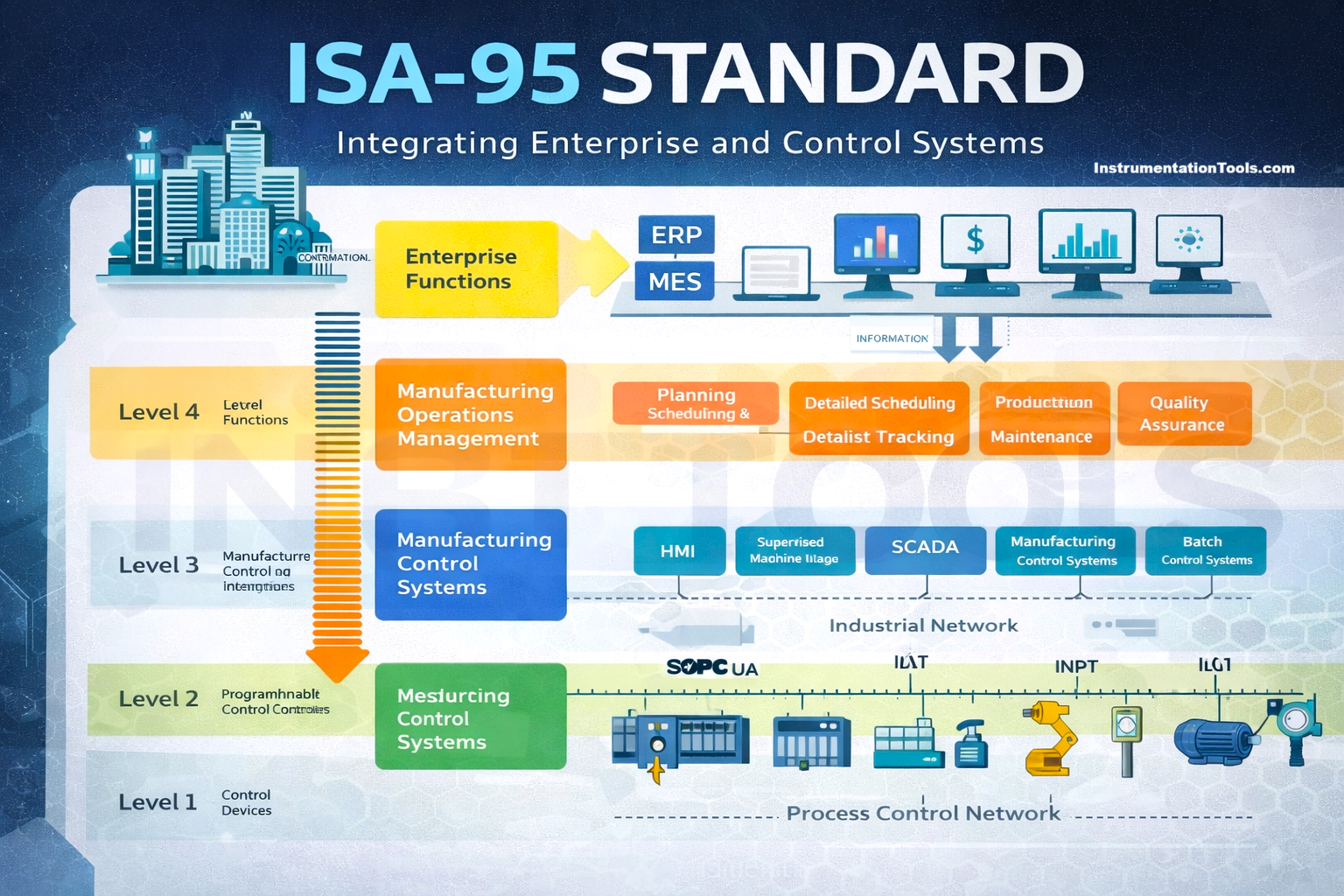
Data exchange between MES and ERP
In an ISA-95–based architecture, ERP and MES exchange information in a structured and controlled way. This data exchange ensures that business plans created in ERP are correctly executed on the shop floor by MES, and that actual production results are accurately reported back to the business.
1. Data flows from ERP to MES (top to down)
ERP sends planning and business-related information to MES. This data defines what needs to be done, not how machines should run.
Typical data sent from ERP to MES includes:
- Production orders (what product, how much, and by when)
- Bills of Materials (BOM)
- Routing and process steps
- Production schedules and priorities
- Quality specifications and targets
This information allows MES to prepare the shop floor for execution without exposing ERP directly to machine-level complexity.
2. Data flow from MES to ERP (bottom to top)
MES sends actual execution results back to ERP. This data reflects what really happened on the shop floor.
Typical data sent from MES to ERP includes:
- Actual production quantities
- Material consumption and scrap
- Batch and lot traceability information
- Equipment performance and downtime
- Quality results and deviations
ERP uses this feedback to update inventory, costs, delivery commitments, and performance reports.
ERP works on planning time scales, while MES operates in real or near-real time. MES acts as a translator and filter, converting raw machine data into meaningful production information. This separation avoids system overload, reduces integration risk, improves cybersecurity, and keeps both systems stable.
ISA-95 in real projects (practical view) and when not to use ISA-95
In real industrial projects, ISA-95 is not implemented as a document, but as a way of structuring systems and responsibilities. On the shop floor, PLC or DCS systems handle all real-time control, such as sequences, interlocks, alarms, safety logic, and machine operation. These systems focus only on running the process safely and efficiently and are isolated from business-level complexity.
Above this, an MES system aligned with ISA-95 manages production execution. It receives production orders from ERP, breaks them into executable tasks, assigns them to lines or machines, and tracks actual production, downtime, material usage, quality checks, and equipment status. MES also provides dashboards, reports, and compliance records using structured ISA-95 models.
At the top, ERP systems manage planning, inventory, procurement, costing, and customer orders. ERP does not communicate directly with PLCs. Instead, ISA-95 ensures that ERP and MES exchange only meaningful, standardised information, making integrations cleaner, scalable, and easier to maintain across vendors and sites.
ISA-95 may be unnecessary or too heavy in:
- Small standalone machines or OEM skids
- Simple plants without ERP or MES systems
- Low-volume or manual production environments
- Projects with limited integration requirements
- Temporary or pilot automation setups