In electrical substations, automation is very critical to operate. This is due to the nature of working where safety, functionality, and operation of the equipment are maintained at a very high level. Traditionally, if it was required for two relays to interlock with each other, then it was done by hard wiring. But now, due to advanced complexities and the need to reduce wiring, a special type of communication protocol called GOOSE is being used for such applications in substation automation. In this post, we will see the concept of IEC 61850 GOOSE communication in substation automation.
Why is GOOSE required in substation automation?
Suppose there is a transformer relay and four breakers (one breaker each in a panel, and the panel is fed by a transformer). The breakers will remain closed as long as the transformer relay is healthy. If it trips, then all the breakers should open immediately and trip the circuit to block faulty current from being passed further to the load by the transformer. Traditionally, this would be done by hardwiring interlocks, by linking relay digital outputs and inputs of these elements. But if the distance between the transformer and the breaker panel is large, then wiring too would become cumbersome, increasing installation and maintenance costs. This brings GOOSE into the picture.
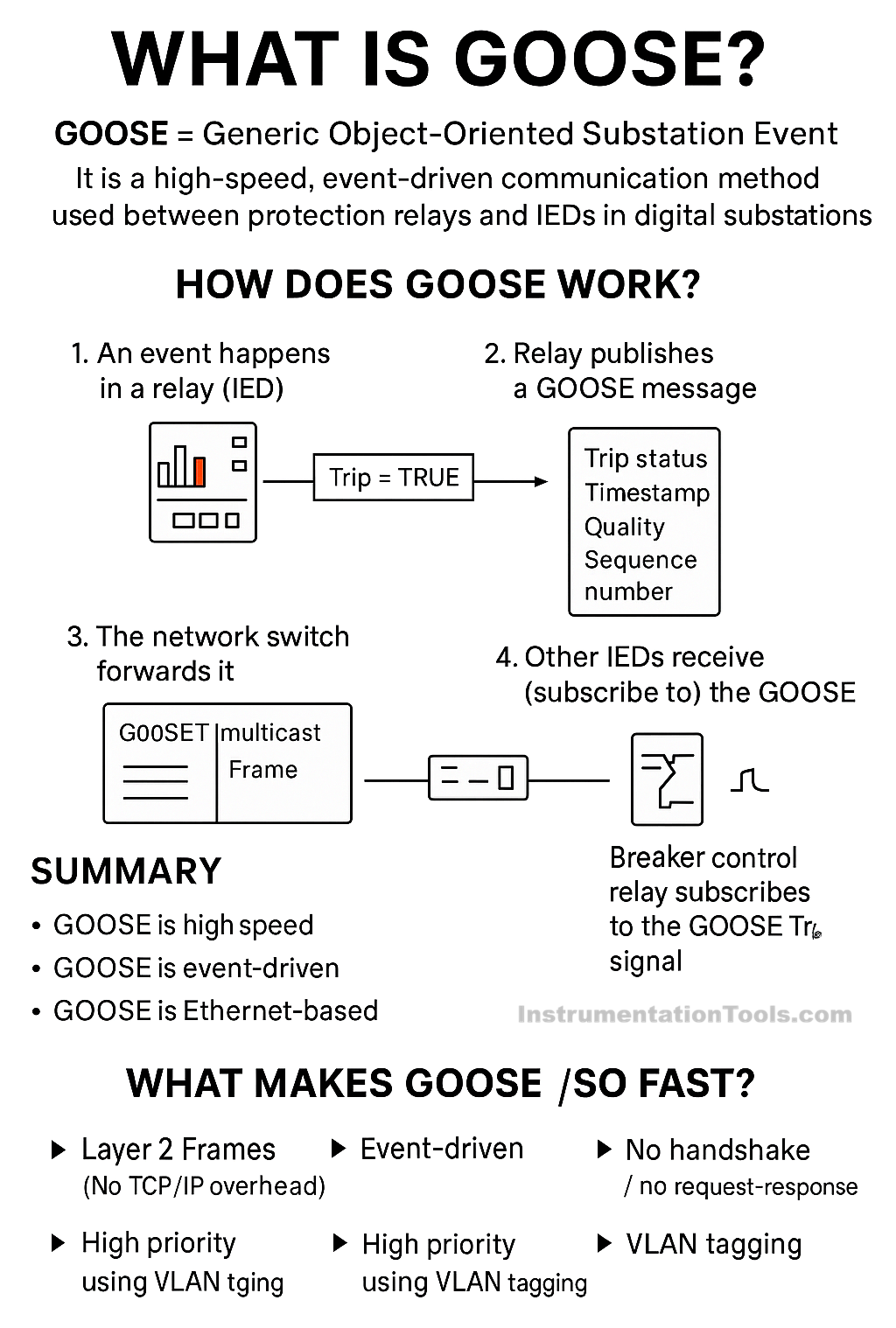
GOOSE is a communication protocol maintained by IEC 61850, which uses Ethernet as the hardware layer. It is specifically designed for substation automation. It is a high-speed event-based communication, which transmits critical data in just 3-4 milliseconds. This also reduces wiring and complexity. Multicast communication is done very smoothly; any change requires only programming changes, which saves engineering hours, and the system thus becomes reliable and easy to operate. We will see below in detail how GOOSE actually works.
What is GOOSE, and how does it work exactly?
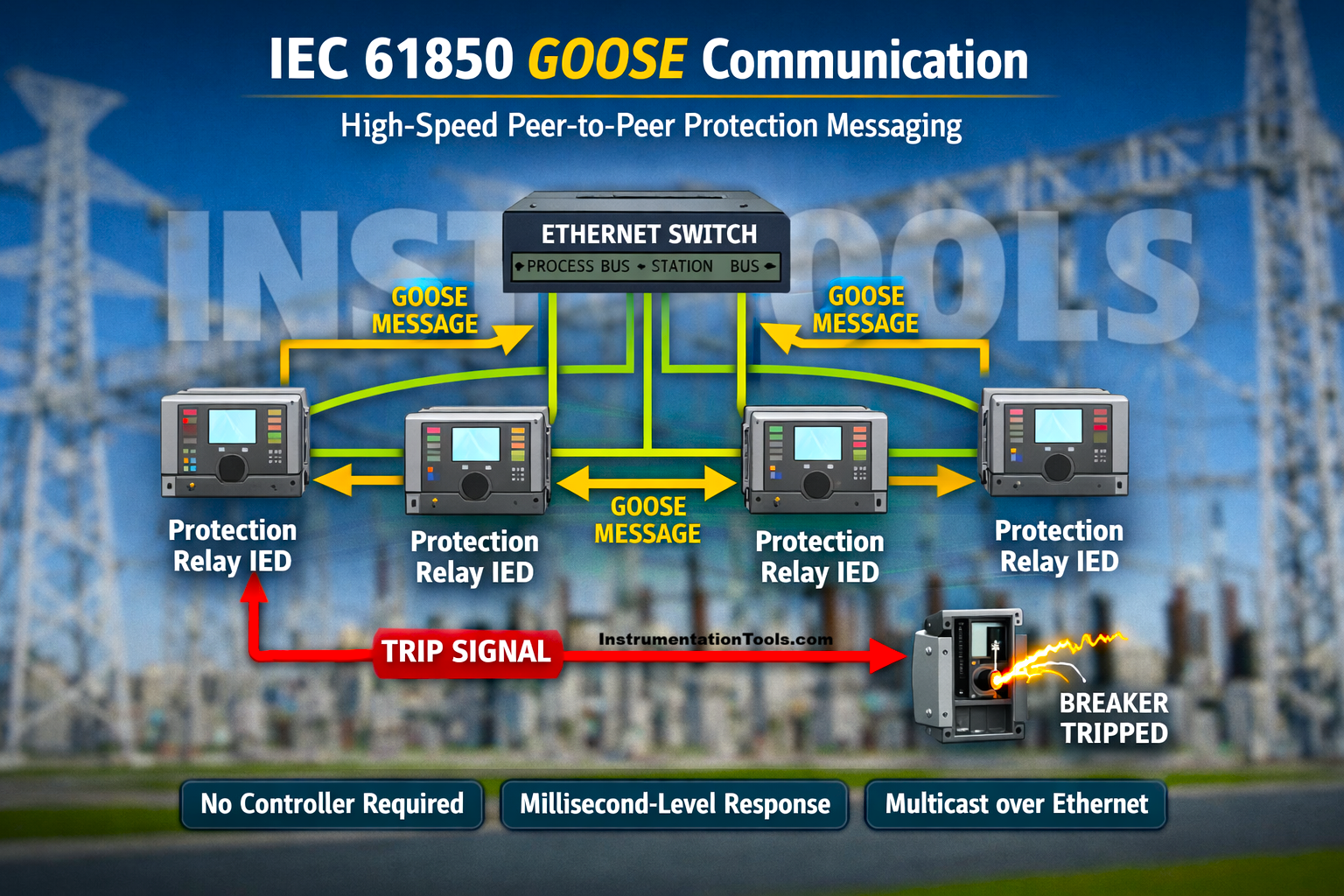
GOOSE stands for Generic Object Oriented Substation Event. It is based on the publisher-subscriber model. So, as the name and meaning say, this communication sends data only when an event is triggered through a publisher. So, in our example, the transformer relay will be the publisher. Subscribers who have subscribed to the event will get data immediately, which in this case will be the four breaker panels.
As there is no continuous communication of data, such event-based logic makes the protocol one of the fastest to operate, which cannot even be replaced by modern industrial and fast protocols like Profinet or EtherCAT. The protocol is based on and developed by IEC 61850, and is used for communication between intelligent electronic devices (IEDs over Ethernet. The protocol is widely used for tripping, transformer, and busbar protection, load shedding, interlocking, and breaker failure protection schemes. Let us understand how it’s working below.
As discussed before, GOOSE has a publisher and multiple subscribers, connected via Ethernet. In normal conditions, the communication shares heartbeat data slowly, just indicating that the publisher is alive or the network is healthy. Now, suppose some event occurs, like overvoltage is detected in the transformer. This event will immediately become first priority and broadcast messages to all the subscribers. Irrelevant of whether a subscriber is present or not, the publisher will send data rapidly as Ethernet Multicast with the current status, timestamp, quality, and sequence number. So, there is no handshake or acknowledgement here.
The subscriber will listen to this message and perform its internal logic quickly, as written in its program. Remember that all this is done on layer 2 of the OSI with no TCP or UDP overhead, making it very fast. It also has a retransmission time frame, where it waits for some time and again sends the message to the subscribers, so that data is received by all of them, and also informs the newly connected device subscribers of the current state, ensuring no one is missed.
GOOSE communication
Some important points to remember for GOOSE communication are:
- GOOSE is configured using SCL (substation configuration language) inside IED devices, which includes many types of file types like IID, CID, ICD, and SCD. All the signals are defined in these files. Each IED device has its own software based on the manufacturer’s design. But different vendors can talk with each other. So, a Schneider relay can subscribe to data received from an ABB relay. GOOSE is simply programmed by choosing which signals to publish, which signals to map for subscription, how to link them to hardware relay IO’s, defining priority tags, and setting GOOSE control parameters.
- If the subscriber fails, then the publisher will send data. Then it is the job of local IED programming done in subscribers to detect its fault and safely shutdown that device, and its related circuits. Critical hardwiring is still done in the subscriber to manage such faults and safely trip the system. Usually, the data of subscribers is shown in SCADA, and it will know which IED is active and which is not, to take action accordingly.